
The relationship tango — the purpose of a relationship is the personal growth of both of the people in the relationship. This flies in the face of the romantic notion that relationships are there to get my needs met. Often, people think that what they see in movies or on the soaps is “real.”
Psst!! Hey!!!
** Want more great writing designed to help YOU to shift your behaviour?
** Want to learn how to find, build or deepen your principal relationship?
** Want to know more about Zen living and being?
Check out Wayne’s books! (amazon link)
Or, check them out right on our site.
Let’s take a look at how our relationships are indicators of our personal development.

You’ll know that Darbella and I think that relating is not about relationships. (There is no such thing as ‘a relationship.’ There’s just two individuals who choose how they are going to relate.)
The purpose of a relationship: the best place to encourage personal growth for both of the people in the relationship.
This flies in the face of the romantic notion that relationships are there to get my needs met.
Often, people think that what they see in movies or on the soaps is “real.”
That you find your ‘one true love’ through kismet or karma, that you fall deeply and romantically in love, and ride off into the sunset on the gondola of bliss.
Reality is often much harsher, as is evinced by this “much mentioned but slightly inaccurate” statistic: there’s a 50% divorce rate – and that’s just for first marriages. Second marriages actually fare much worse – nearing 75% failure.
Why?
Because people who get divorced the first time do not learn the lesson – do not understand the purpose of a relationship. They think they picked the wrong partner, and that next time they’ll pick better.
So, typically, they marry the opposite of the first schmo (Yiddish – schmuck) and think, “Great! Right partner this time! Now I can really get what I want!”
All they do is end up miserable faster.
They already know a divorce lawyer, so the 2nd one typically ends quicker. Unless they are stubborn.
All relationships start with romance… the hormone driven start of a pairing.
In my book, This Endless Moment, I wrote that hormones are there to get us to breed, and nothing more.
The endorphin rush felt at the first blush of love is nothing more than a drugged state designed to get the two people to ignore each other’s true nature long enough to cause them to procreate.
This is the reality of all of our relationships, assuming that we started them only on the basis of “love, lust, and hormones.”
Oh sure, we’ll deny that this is what we are doing, but how else to account for the startling realization, some months in, that my partner is not who I thought she or he was?
All of a sudden, I’m noticing flaws. Flaws!!!
We then enter the Conflict stage, and that one we all know. It’s when we try to change our partner, first through wheedling (‘If you loved me, you’d change!”) then bartering (‘I’ll do this for you when you do that for me…’) then blackmail, threats, fights, separations.
All of this is a result of feeling gypped – I didn’t get what I thought I was getting.
I saw a quote that I wish I’d written down. It was something to the effect that:
My partner is who (s)he is in his or her totality – everything from start to finish.
My partner is not just the last thing he or she did.
This is an interesting thought – and like most things, is paradoxical in nature.
- First, fights start because of what is happening right now.
- Second, it is unusual, when we fight, not to drag in the kitchen sink – all of the other supposed sins of the past. And…
- Third, my partner may be exhibiting new behaviour. This does not negate the past behaviours. It is added to the past behaviours, creating a richer picture.
Without belabouring the obvious, the fighting stage is a crucial one.
Some people fight forever.
I remember counselling one 60-year-old who had been married 40 years. In October, she stated: “My Christmas will be ruined again this year. He won’t hang the lights right.”
I found out:
a) he’d never hung them right
b) she always took that as a sign he didn’t love her
c) she’d berate him and he’d stop talking
d) this had been going on for 40 years AND
e) she’d never once told him how she wanted the lights hung, because “He knows, and hangs them wrong to spite me!”
They went to the grave fighting.
Others, like many of our parents, (before divorce became socially acceptable,) do not fight. They simply live separate lives, sharing the house and the kids, and acting like roommates with privileges. This is the stage of apathy.
Or, you get a divorce, learn nothing, and do it all over again.
The way out, which we’ll look at in detail next week, is dropping the need to be right, letting go of the fighting, and simply getting curious.
So, back to the thread of this article.
The purpose of relating is to deepen your self-understanding. That’s it.
All the rest, including having kids, is secondary.
All the ‘stability of the nuclear family’ is so much propaganda – remember the 50% divorce rate? And most of the remaining couples, perhaps 45% are staying out of guilt, fear of failure, or just plain fear. The kids survive anyway.
The purpose of life is not simply to breed and to die. If there is a purpose, it is to deepen our knowing. Relating is a perfect place (therapist David Schnarch, author of The Passionate Marriage, calls this a crucible) to learn to see myself.

Back before I retired, my clients told me that I was the only person who truly saw and accepted them.
This is both true, and sad.
I see people as they are because I have no wish for them to be other than they are.
And, I encourage everyone to be all that they are – to drag out the scary, juicy, stuck, chargy, dark, horny, happy, depressed parts, and to try them on for size.
I continue to do this without judgement, because I am curious and interested in the totality of their being – not just the politically acceptable parts.
My dance with Darbella is the same. I cannot ever remember wishing to change her, nor have I ever judged her. We have fought a few times in our 4 decades years together, when both of us got stupid at the same time, but we turned each fight into an exploration, not a battle.
In a sense, we chose to leave conflict behind for co-creativity.
You need to look at your principal relationship, or look at how you are keeping yourself out of one if you don’t have one.
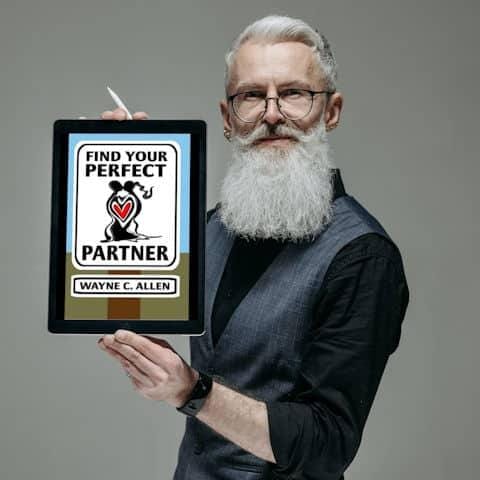
Find Your Perfect Partner
If you are not in a relationship, and want to do a much better job finding a partner that suits you, have a look at my book, Find Your Perfect Partner.
You’ll find the tools you need to engage your brain!
Direct link to Amazon for all formats
Purchase digital versions (Apple, Nook, Kobo, etc.) from this page
Note: If you are not in a relationship, and want to do a much better job finding a partner that suits you, have a look at my book, Find Your Perfect Partner. You’ll find the tools you need to engage your brain!
I’m not advocating for marriage. Many of my friends have principal relationships at a distance, or with friends. The point is, each person need to be in constant contact with at least one person – a dance and dialog where I get called when I get off track.
In my view, it is not sensible to be in a relationship that I am not at least neutral about. If I am angry and judgemental most of the time, why am I there? I need to move on.
If I am at neutral, and my partner and I have (mutually) made a pact of self-exploration (usually with the help of a therapist) I must let go of conflict and choose curiosity.
The reason for dropping conflict and choosing curiosity is simple – conflict steals my energy. I end up railing against my partner, blaming him or her for everything lame and weak, and stupid in my life.
This is altogether too convenient.
Monitor yourself and your gut sense of your principal relationship. You do not have forever, and apathy and lame acceptance is simply that – lame.

Simple, profound lessons in relating
The. Best. Relationship. Ever.
Purchase all formats at Amazon
Purchase digital versions (Apple, Nook, Kobo, etc.) from this page