
Changes of Behaviour — letting go of blaming externals is hard, but blaming externals means staying stuck
Looking for more on this topic?
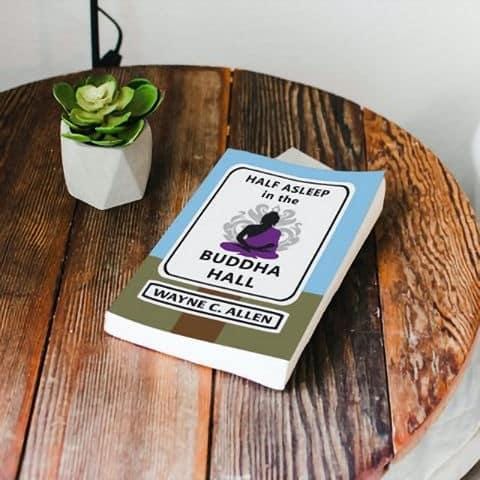
Check out my book,
Half Asleep in the Buddha Hall.
My “Eastern” book takes you by the hand and helps you to find peace of mind.
Half Asleep in the Buddha Hall is a Zen-based guide to living life fully and deeply.
(Here’s a direct Amazon link)
Purchase digital versions (Apple, Nook, Kobo, etc.) from this page
We recently celebrated our 40th wedding anniversary. This caused me to think about a wedding we went to back in 2013. In Costa Rica.
There were things to see and people to watch — that trip was our first time in the Sámara area. Liked it so much we keep coming back.
Anyway, I remembered a couple of odd things from the wedding weekend.
Example the 1st: One guy there liked to think he pretty much knew everything and really did spread it thick.

In the process, he became more and more alienated from his grown children, and from his wife.
One thing he claimed was that he had great proficiency with meditation.
Always followed by, “I’m so stressed by: “work, the behaviour of…, traffic, travel, expectations.”
He also mentioned how meditation kept him from biting on stuff, always followed by, “But this time (the stuff) is serious and anyone would have bitten.”
Example the 2nd: The other thing of note was more bizarre than noteworthy.
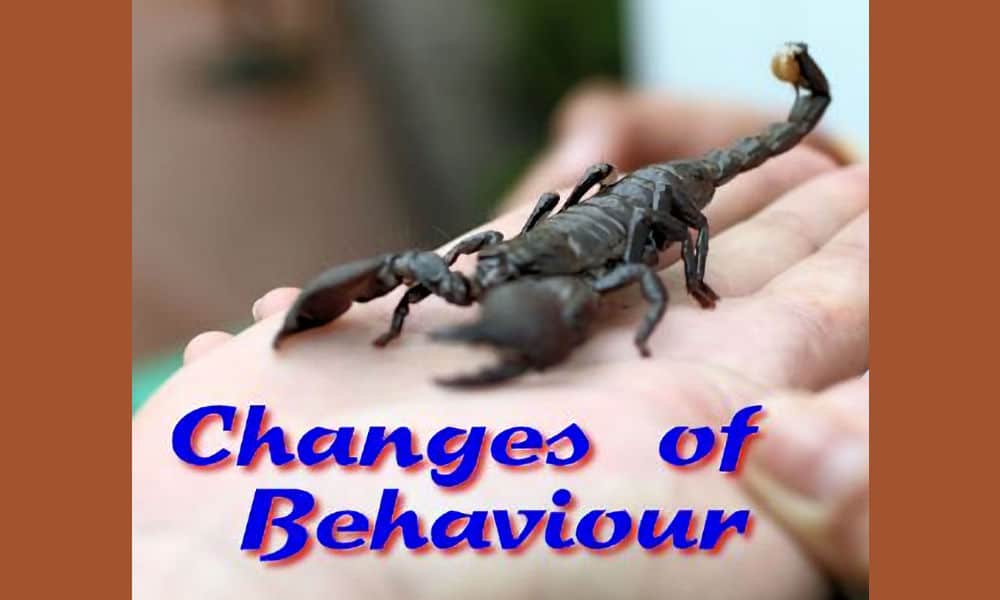
Two people saw scorpions in their rooms, and one guy got bit (it was hiding in his shirt…)
Here’s the odd part: the guy who got bit yelled at the hotel owner, and coerced him to give him another room. Because, obviously, he’d been given the “Scorpion Room,” and all the others were somehow scorpion free.
The stories actually dovetail, as in both cases, the parties involved think that externals are more important than internal self-responsibility.
In story 1, externals trump choosing to remain calm and centred. In story 2, expecting a room in a jungle to be “pest free” trumps learning to check your room, keep your suitcase zipped, and examine your clothing.
It takes constant vigilance to move from blaming, to self-responsibility, to behaviour change. Each step is as complicated (or easy) as the person involved chooses to make it.
In terms of behaviour, it’s like this:
Our prime purpose in this life is to help others. And if you can’t help them, at least don’t hurt them. ~ Dalai Lama

Helping others is never about lectures, as you really have little knowledge of where the other person is coming from.
Being helpful sometimes means just watching.
It never means trying to berate, belittle, and badger others to go along with you.
It sometimes means listening and hearing, without trying to fix.
It always means being present for “all of it,” calmly, with centredness, and not choosing to bite, even when the scorpions bite you!
Stages of Movement

Blaming is insanely popular, and because we live surrounded by people and scorpions, it’s always something.
Finding a blame target, given a lifetime of examples is stupid easy.
Yet, I still think it’s weird to blame others or the past for what is going on in the here and now.
The stories we tell ourselves aren’t “true” — they’re just whatever we choose to make of our past.
Self-responsibility is the first leap out of “normal.” Self-responsibility is realizing that, 100% of the time, the results I am getting are a direct result of “the questions I am asking, and the things I am doing.”
I lose the idea that I am being acted upon by some outside force. I discover that what’s going on in my “package” is me, doing me.
I then can pause long enough to notice that I am winding myself up over what I think — over my stories — and I can breathe and let go.
Where all of this can get difficult is that people start using self-responsibility and self-awareness as a tool to avoid true intimacy. It works like this:
I examine myself and begin to see my games, my illusions, and my most common “blamings.” From this place of increasing clarity, I make the fatal decision to become a guru.
Just like the guy at the wedding, who really does think of himself that way.
“Guru-ship” happens when people shift to teaching (lecturing, berating) others, without first doing the hard work of letting go of their games.
Because it’s one thing to know it, and another thing to stop it.
I hear, “Don’t you see how hard I’ve worked figuring out myself? I know me and what you see is what you get. Given who I am and what I’ve been through, I’m doing the best I can. How dare you challenge me to actually change my behaviour!”
Next, it’s not simply accepting that I must stand on my own two feet. It’s not enough to understand that Darbella is Darbella, and I am me, and that my stuff is my stuff, and hers is hers.
Once I “get” the concept — I must ruthlessly weed out any behaviour I engage in that flies in the face of this understanding.
Each time I slide back into “entitlement thinking,” for example, I start by paying attention and noticing as I go there.
If I am not paying attention, and “suddenly” find myself there, I wake myself up, stop my game playing, and move on.
This is my responsibility.

Tilley hat optional
This how I have learned that my entitlement gets me nowhere. (Remember, the stuff that causes us grief does not go away. We just get better and better at identifying it and dealing with it differently.)
Then, (here’s the hard part), I stop myself from justifying being there.
If I choose to do this, I suddenly have the option of choosing a different behaviour.
“Here I go, acting like an idiot. I’ll stop myself now.” This, both simple and incredibly difficult, is the key to self-responsibility.
Self-transcendence comes as I can learn to let that part of me (the ego-driven part) shrink with disuse.
Or, every time something is up, you can deliver a lecture and sit in smugness. Or, you can demand to leave the Scorpion Room for the room that never, ever, has an issue.
Both approaches are the height of silly, so think twice, eh?
And when in Costa Rica, always remember to shake out your shirt!