


The joy of non-duality — we create internal representations of everything we interact with. It’s all just a story. Joy is letting go of all of them.

Looking for more on this topic?
Check out my book,
Half Asleep in the Buddha Hall.
My “Eastern” book takes you by the hand and helps you to find peace of mind.
Half Asleep in the Buddha Hall is a Zen-based guide to living life fully and deeply.
(Here’s a direct Amazon link)
Purchase digital versions (Apple, Nook, Kobo, etc.) from this page
In my book, This Endless Moment, I make mention of the Radical Constructivists and the line, (paraphrased) that we should put reality in quotes — “reality.”
The gist of the argument is that, while one can argue philosophically for an independent “reality,” – a world of things, this is an abstraction.
Many mental games to play today.
First Experiment: take a look at the lead image— the one with the photograph of a woman in a robe, and my painting of the photograph.
Tell yourself some stories about the two images, as they relate to the woman.

Second Experiment: think of a woman you just met. Does “she” have an independent “reality” apart from you? And, what’s her ‘real’ story?
Now, before you leap too quickly to getting the butterfly net, think about it.
- ‘She’ did not exist, for you, before you met her.
- After you met her, she became ‘real’ (for you) and exists in your world.
- What you know of her is data contained in your mind.
- Therefore: ‘she’ (logically, empirically, a priori, objectively) exists separately from you, (out there, somewhere), but you can never prove it.
Why? Because everything you learn about her is subjective. It’s your story. What you see are your observations, and then you interpret them (she’s tall, she’s pretty, she comes from a deprived childhood. Whatever.)
Now, imagine that her brother shows up and tells you stories about her childhood. Now, it’s even weirder.
He is telling you stories about what he observed (thus, they are about his observations, not about her) and you are listening to and evaluating him and his stories, while no doubt thinking you are learning more about ‘her!’
In all of this, what is ‘real,’ and what is ‘true?’
Before you leap in and say, “She is real, and her brother is real!” (and I agree that this is so, despite the fact that we’re arguing about an example I just made up…) what can you know of her… or of anyone else… including yourself?
You can only know your interpretation of what you “observe” — what you see, hear, taste, smell, feel, or ‘cognate.‘
That last one is, in Buddhism, the sixth sense. Cognition, or defining, is a mind game going on in your head.
Sensory data comes in, and you interpret it and then give it a meaning.
If you see a box, and say, “It’s a small box,” the “real” part is the box.
Small is relative, as it means, “Small, compared to…” The box does not have “small” as a characteristic—it is not a part of its nature.
Small (red, rough, etc.) are descriptors (judgements, interpretations) you have added. (Nice, cold, angry, bad, good, fat, smart, stupid, etc.)
Interpretations made in your head about someone or something are not ‘true.’ They’re just your stories.
How does non-duality fit in?
Well, when you interpret (and we all do this, all the time, with every object we come into contact with) you are creating a duality.
The first and primary duality is the picture in your head. As above, it’s yours. It has nothing to do with the actual object / person.
In our experiments, if you decided that the woman is pretty, this is a subjective judgement, and implies, “prettier than…”
It also means, “Not ugly.”
Same with any characteristic you put on a thing. A characteristic you invent to define something is not true and ‘real.’ It is a label you have invented, and it is always like this:
A is ‘x’.
Therefore,
A is not the opposite of ‘x.’
This is important. The idea that your version of “reality” is “true” is the cause of every problem you and the world has. “I am right, you are therefore wrong.” “This behaviour is good, you are doing something else, you are bad.”
Things are actually everything and empty of everything — non-dual
You must understand that this evaluative process is who we are as human beings. It’s the one and only thing we do as we interact with the world. Just like meeting someone for the first time, no one (or thing) exists in our world until we begin to describe it.
Go ahead, try. Name one thing you have never experienced, but think is ‘real.’
Let’s say you came up with a village in Mongolia. You shout, “See! That exists, and I’ve never been there!” Nope.
The village you saw in your mind exists only in your mind (let’s say you saw a picture of it…) and it began to exist in your mind when you experienced it (saw the picture.)
Prior to your actual involvement with the picture, you had no knowledge of that village. AND, you only know the picture, which may be of a village that no longer exists.
What we need to get is the idea that, just because we believe something about someone or some thing, that doesn’t make it ‘real’ or ‘true.’
It’s like the Elephant story:
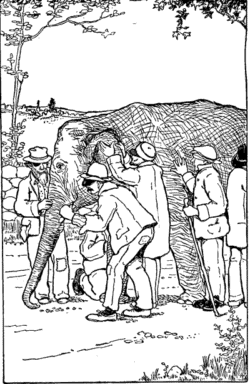
Six blind men were taken to ‘see’ an elephant. Each walked forward and touched a part of the elephant.
- “Hey, the elephant is a pillar,” said the first man who touched his leg.
- “Oh, no! It is like a rope,” said the second man who touched the tail.
- “Oh, no! It is like a thick branch of a tree,” said the third man who touched the trunk of the elephant.
- “It is like a big hand fan” said the fourth man who touched the ear of the elephant.
- “It is like a huge wall,” said the fifth man who touched the belly of the elephant.
- “It is like a solid pipe,” Said the sixth man who touched the tusk of the elephant.
The wise person recognizes that each blind person has created a “reality” called ‘elephant.’ Each “reality” was based upon what each person had observed (in this case, touched) and upon each one’s interpretation.
Now, in some versions of this story, a Master comes along and says something about religious arguments being like this.
In a Jain version, the verdict is that an elephant is all the things observed.
This begs the question. Is it possible completely to define ‘elephant?’
Of course not.
One could spend one’s life watching, observing, dissecting, digging into an elephant. Then, you would have general data you might (carefully) apply to ‘all elephants.’
But you see the flaw. Each time a new characteristic pops up in another elephant, (this elephant is taller!) you have to change the definition.
But, you argue, at least I know one elephant.
Wrong.
You were never able to enter the elephant, and be the elephant. Thus, you will never ‘know’ even the one elephant. All you have is data concerning what you think you observed. Another blind man, feeling up an elephant.
Nor will you ever know anyone.
Including yourself.
All you will ever experience is ‘this, now.‘
And you will add your description of what you observed
to your database,
as we are wont to do.
The wise soul makes no judgement regarding their judgements.
And surely, it is best to never have the judgement that what one believes is either ‘true’ or ‘real.’ It’s just what you interpret, today.
For me, non-dual thinking is this:
- I am here , in this moment, and this is how I am judging and evaluating the experiences I am apparently having. I watch myself judging and evaluating, include my evaluations in what I know of me, and let that be enough as far a judging goes.
- Next, I choose what to do next (obviously, my actions can only be based upon my judgements and evaluations, and based upon what I know how to do. We learn everything incrementally, based upon some action that came before.)
This non-dual approach is one of acceptance. I accept all of my experience.
I accept the understanding that I’m
making it up as I go along.
Thus, all there is, is me, and me is defined by how I interact with other individuals whose story I incorporate into my being.
The only part I can modify
(deal with, explore, let go of…) however,
(and this is the hard part)
is me and my story.