

You’re on Your Own — no matter what you think is going on, your experience is being invented by you.

Living Life in Growing Orbits is our workbook.
52 weeks of daily exercises designed to help you figure yourself out.
Check out Living Life in Growing Orbits on our site.
Direct link to Amazon
Purchase digital versions (Apple, Nook, Kobo, etc.) from this page
So, about Substack… kidding, sort of.
I’m getting close to shifting this blog over to Substack. I’m waffling on keeping The Phoenix Centre Press site going. My books are for sale everywhere, so linking to them on Substack may be enough.
But the reason that I mentioned Substack is that (of course) I subscribe to several blogs or whatever they call them, and I’m seeing the value of the simple format.
One that I subscribe to is written by a therapist I trained with back in 1981–83. Her language is quite different from mine, and it’s interesting to see her describe her process.
In a nutshell, her last article was about what I call self-responsibility.
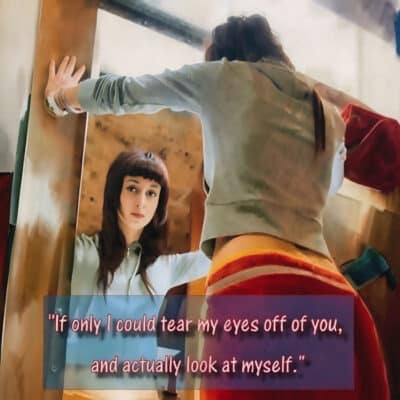
When I use this term, I’m talking about taking responsibility for the “whole enchilada” — not for externals, but for what we do with externals.
I say it this way as a means of cutting to the chase — if we are to come to our senses, we need to bring our focus to what we can observe, and sometimes even shift.
We want to focus on our stories
I linked to my workbook, Living Life in Growing Orbits, above, because I address this in the very first chapter. I suggest exploring your “Rock Beliefs.” These are the understandings that are so old and deeply dug in that they seem unassailable.
Most don’t even know what they are. So quickly are they enacted that there’s barely a blip between stimulus and response. But just because it’s almost instantaneous doesn’t mean we can’t find the gap, an insert a thought — a choice.
My friend’s article was exploring a similar way of thinking, and engaging in what I would call “letting go.” Stimulus -> recognition -> choice -> implementation of another way of being.
When I was in training, I’m sure I learned a communication model. I definitely learned one while studying at The Haven. I’ve mentioned this before, and included it in my books, but the Haven Model looks like this:
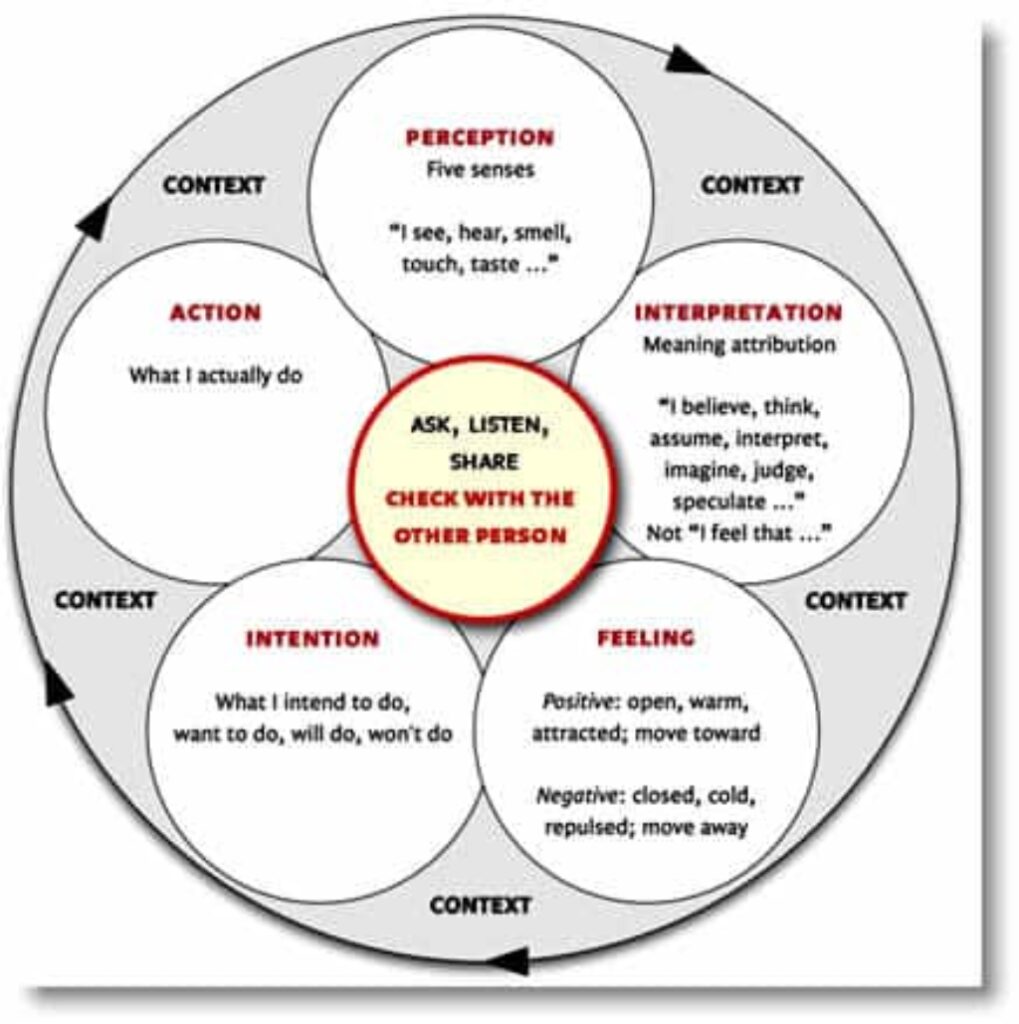
What we like about this model is that it encourages you to speak clearly and self-responsibly. It’s described as “using ‘I’ language” for short. And people do learn to speak this way.
We work to push it to the next level. For Darbella and me, it’s a lifestyle choice. We not only use it, we have committed to correcting ourselves when we mispeak. You get better at it by always fixing your language.
Let’s look a how this might “flow.”
As you can see from the chart, it’s drawn to suggest that any of the five outer circles might trigger first, and they also can trigger in any order. This is so. However, I think the pattern I’m describing here is pretty common.
I am hanging out with a friend, and she is looking around, checking her phone, shaking her head, sighing, and her responses to my questions are delayed.
The Model calls this perception
Perceptions are raw data. It’s what’s out there, it’s neutral, it’s just stuff. Stuff has no meaning.
So, I take in that raw data using my eyes and ears.
The data hits my brain. Until it does, it lacks meaning. My brain takes in the data, and first of all labels it. As above. “Looking around,” etc. It then, immediately, begins the process of evaluation.
“She’s ignoring me. She’s mad at me. She’s disrespecting me. She hates me. She no longer wants to be my friend.”
This is the Interpretation stage
This stage, for most, goes on internally. Yappity Yap, we talk to ourselves, judging the external stimulus and fitting it in to our Rock Beliefs about how others treat us, or whatever.
Simultaneously, as our brain does its thing, our bodies are being hit with hormones generated by the thought patterns, and “we feel.” If you look at the model, you see things like hot, cold, near, far, etc. Tightness / looseness. These are feelings.
This is the Feeling circle
A feeling is physical. Thus, “I feel you don’t like me” is NOT a feeling. It’s an interpretation. Just listen to yourself and your friends, and you will hear this silliness all the time.
All of this is going on in the blink of an eye. And sure, you might feel the feeling first and then generate the interpretation. Whatever.
I decide that I’m going to get up and walk out. Or I decide that I am a “nice” person, so I stuff my interpretations and feelings, while judging that my life sucks. More internal processing.
This is Intention
I shake my head, look at my friend, say “You are disrespecting me,” and leave.
This is the Action
OK. Let’s have a look, eh?
First, notice that everything that went on, until the action, was happening inside me — the observer. Sure, the behaviours exhibited by “my friend” were external to me, but again, they are neutral until they “enter” my head and I start messing around.
Before I look at what I consider a “better” approach, here’s a tad more info. What I didn’t know (because I hadn’t asked) was that my friend’s mother was having heart surgery and she was waiting for news.
Change anything?
We all make the same assumption about our assumptions: we take in raw data and think we know what it means. We do this endlessly, and even more so with people we love — as in family, friends. I hear it all the time.
“He’s my father / son, and he said or did this, and he did it because…” “My wife never understands me!” “My children are disrespectful!” And all of it is “me” interpreting what I think I say based upon what I think I know.
Let’s say I decide that my friend was disrespecting me.
Here’s a hint. They can’t. They can only do whatever they do. The “disrespect” part is you, in drag, taking on a role, and blaming another, based upon your Rock Beliefs.
But it confirms my pre-held thinking (my stories) and I’ve reacted this way forever — “It’s just the way I am!” so I keep doing it and trying to convince others of the “rightness’ of my twisted Rock Beliefs.
What’s the Alternative?
Here’s what an elegant presentation of the model, above, sounds like.
Perception
“So, I notice that you are fidgeting in your seat, looking at your phone, and seem distracted. I notice that you haven’t responded to my comments and questions.”
All of this is factual. It’s “what’s happening.”
You now have a choice.
Let me “do” the rest of the convo as if I were talking Darbella. Then I’ll do “a friend.”
I’ve already started at the top, with “Perception.” As Dar and I have a contract to always use the Comm Model, I’d want to “run the model” so she gets yet another example of my weird internal theatre.
Feeling
“I’m noticing that my body is tight, my stomach is grumbling,
and I’m feeling distant from you.”
This is the Feeling Circle. I am reporting what sensations I’m noticing in my body. Not debatable, as they’re feelings… in MY body. Notice that this is not “I feel that you are ignoring me.” (I’m not stupid. I know the difference between a feeling and an interpretation.)
Interpretation
“The story that I am telling myself (or I’m judging) is that you are mad at me, and are punishing me for something, and don’t want to be here with me.”
Darbella and I love the clause “The story that I am telling myself…” Learned it, of course, at The Haven. We like it because it is such a clear reminder that our minds are inventing stuff all the time, baaed upon what we believe to be so, and it has no basis in reality. IT’S A STORY!
Intention
“My first intention is to get all self-righteous and judgy, blame you, and try to manipulate you into making me feel better. My actual intention is to tell you what I’m spinning in my head, and invite your feedback.”
I then ask for feedback. I invite sharing, so that I can hear what is actually going on for Dar, as opposed to what is going on in my head as I “play Darbella in drag.”
Action
Action
“Would you tell me what’s up for you right now?”
With a friend, or anyone that doesn’t know this model. I’d want to step through all of this in my head. I catch myself before I buy into my self-created stories, and say:
“The story I’m telling myself is that you seem distracted,
and I’m wondering what’s up for you?”
Really?
Yup. Dar and I have been following this model since 1996.
As an example, I might say, “That person really pisses me off,” and as those words flow out of my silly head and mouth, I say,
“Whoops. Let me try that again. “I am really choosing to piss myself off over the stories I’m telling myself about that person.” ”
Really?
Yup. Every time. No letting me off the hook. Stupid needs catching.
We really need to look to our heads and the myriad of games and storytelling go on between our ears. Letting it go on unnoticed and un-dealt-with is simply lazy. In Buddhism, this is the point of being present.
No expectation that the game will stop, but a strong understanding that we can pay attention, create a wedge between — stimulus — story — response. That we can catch ourselves, and finally become, moment by moment, self-responsible.