

Examining Your Premise — your beliefs underlie everything you think and do — and most remain unexplored and unexamined. Let’s look at how this happens, and propose a couple of ideas for looking inside

Psst!! Hey!!!
** Want more great writing designed to help YOU to shift your behaviour?
** Want to learn how to find, build or deepen your principal relationship?
** Want to know more about Zen living and being?
Check out Wayne’s books! (amazon link)
Or, check them out right on our site.
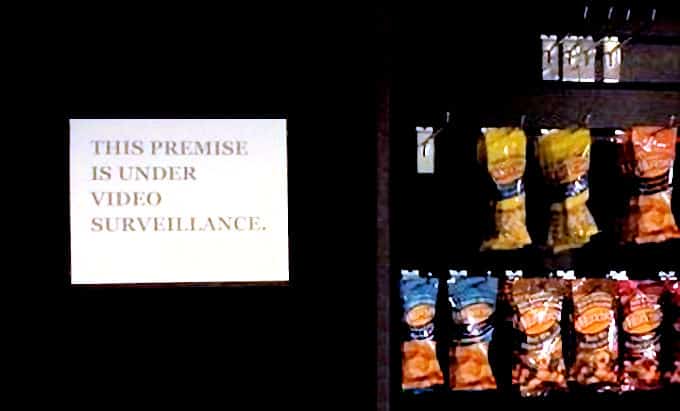
We stayed overnight in Toronto, at a hotel. The photo above was taken in the lobby. The joke is subtle; did you get it?
The word premise is wrong. It ought to be premises.
I’m imagining the trailing “s” threw the sign writer. A “premises” is a single location, and a premise is, “a proposition upon which an argument is based or from which a conclusion is drawn.” Thus, a premise is the basis of a belief or understanding.
I wonder how many of us would like to have our beliefs under video scrutiny
You might think of a premise as a core belief – for example, some people
- believe that others are dangerous, and some believe in the inherent good nature of others.
- believe all people of a particular group are a certain way, and some people treat each person as a “blank slate” — and respond according to the individual.
We’ve learned to hide the underpinnings of our behaviour
Socialization requires blandness. We’ve all learned how to blend in and “not make waves.” We guard what we really think from pretty much everybody.
The work we propose is “learning to flex our surveillance muscles.”

This is decidedly different from trying to figure others out.
Most of us spend (waste) our lives trying to dissect the motives and desires of others — we engage in endless internal dialogues, playing all the roles, as we peck away at our nearest and dearest.
And we never “get” that all of our work is about “me-thinking about others.”
I used to ask clients about their stuff — their world-view, their desires, what path they are “walking,” and I was met with blank stares, or embarrassment. Altogether too scary to explore the quasi-hidden stuff.
Their video surveillance equipment was on pause.
Others replied by telling me who they aren’t, or what they don’t want. Or, they, said, others should figure it out for them.
Just a Note! Back in 1994, My first book, Stories From the Sea of Life was published. It’s now out of print, BUT is available as a pdf file. If you’d like to read more of the stories contained therein, go to the home page of The Phoenix Centre Press. Once there, subscribe to the site’s mailing list, and you’ll get the pdf for FREE!
I wrote this little story in that book: A “Passionate Encounter”
The daughter of one of my best friends came in for counselling one day. After assorted pleasantries, Carol said, “Wayne, all of the passion has gone out of our relationship.” (Carol had been dating Will for six months, and living with him for five.) I asked her what she was doing about it. Carol replied, “Every night, I say to Will, ‘Will, all the passion has gone out of our relationship.’ But nothing ever changes.“
I asked Carol if she’d be willing to play a game with me. We would pretend that we were in a relationship. She agreed. I said, “Carol, all of the passion has gone out of our relationship. What are you going to go about it?“
Carol said, “Well, I’ll make you dinner, and then we’ll drink wine in front of a roaring fire and fool around on the couch.” I said, “Carol, that was a fine dinner, the wine is great and you really know how to fool around, but Carol, all of the passion has gone out of our relationship. What are you going to go about it?“
Carol said, “Well, I’ll buy a sexy nightgown and give you a back rub and we’ll take a shower and then make love.” I said, “Carol, that’s one heck of a nice nightgown, and my back feels great, not to say anything about what you did for the rest of me, but Carol, all of the passion has gone out of our relationship. What are you going to go about it?“
Carol said, “Well … damn it, what do you want?“
I said, “Maybe Will is wondering the same thing.”
Carol learned to ask for what she wanted, instead of endlessly listing what she didn’t want. This internal observation is as difficult as we make it.
1. Self-awareness is not self-judgement
A client once wrote:
“I figure we can spend our lives apologising for who we are. Apologising for not being beautiful enough, for not conforming, for disappointing our parents, for choosing to not earn a million dollars, for going home early, for not loving hard enough, for not making it better, for just about anything.”
Or not.
What if we say this is how it goes down for me? In this 100 years, in this lifetime, I make no apologies for being me. I make mistakes and I’m messy and sometimes I really don’t behave well – because sometimes I just don’t. While I say sorry when I hurt someone else, and try to avoid doing so, there is no apology for being me. Or you.
There is nothing to be gained in apologising for my existence. It’s incredibly rude to want to say sorry for being you. You is what makes the world work, or not. This planet is a billion yous. None of us have any need to apologise for being here right now. We just are here.
This is your story. Yours. How powerful is that?”
2. Self-awareness is seeing your prejudices
A prejudice is a “pre-judgement.” The verdict is in before the evidence is produced. I suspect most prejudices are foisted upon us by tribe, culture, religion, etc. Predictably, we’re quick to notice prejudice in others, and slow to notice it in ourselves.
If I watch myself, I likely will notice a certain tightness, followed by a sense of self-righteousness, when I trigger myself over a prejudice.I’m as as left wing as they come, and I still have a visceral, knee-jerk reaction to right wing conservatives.
I’ve learned to pause… I start by keeping quiet, while I examine what I want to do / say, and then, have another breath. I’ve learned to be critical of a belief, without (necessarily) judging the speaker. After 50 years of practicing this, I seem to deal well with this 90% of the time.
3. Self-awareness is focused on what do
See above. I have not changed my opinion regarding conservatives. What I just wrote about is how I express myself — a doing. My work is all about this: noticing the feeling (in the body) of tightening up, closing down, shutting off. Then, using the body awareness as a “wake up point,” so that rather than operating on auto pilot, I go inside and see what I’m doing to upset myself.
From there, comes the fork in the road
I can still enact whatever knee-jerk retraction I normally toss out, or I can choose to go another way. Darbella describes one of hers as, “In small group I want to pull back and stop talking, so I lean forward and speak.” Our path is not about flawlessness… it’s about choice in the face of our flaws.
4. Self-awareness comes through dialogue
We can and must watch ourselves, and paradoxically, we can’t do this alone. We are so good at pulling the wool over our eyes… finding excuses to repeatedly engage in damaging behaviours, that The Pathless Path requires dialogue.
It’s essential to develop intimacy projects — open, clear, direct dialogue aimed at cutting through the bullshit; getting to the core of the dilemma. In a sense, we do video surveillance on ourselves, and then share the tapes!