


- Zen 101 — Essential Zen Lessons
- Zen 101 — More Zen Ideas
- Zen 101 — Self-Responsibility
- Zen for the Holidays — 10 Tips
- Zen and Clarity — Zen Principles
- Zen and Innocence — Zen Principles
- Zen and Clinging — Zen Principles
- Zen and Karma — Zen Principles
- Zen and Emotional Balance — Zen Principles
- Zen and Simple Presence — Zen Principles
- Zen Living: 5 Ways to Land
- The Emptiness of Everything
- Big Mind
Big Mind — Watching the mind work is how we prepare to live in the moment. Here are some examples of simply watching.

Looking for more on this topic?
Check out my book,
Half Asleep in the Buddha Hall.
My “Eastern” book takes you by the hand and helps you to find peace of mind.
Half Asleep in the Buddha Hall is a Zen-based guide to living life fully and deeply.
(Here’s a direct Amazon link)
Purchase digital versions (Apple, Nook, Kobo, etc.) from this page
Do you ever think about how you think? I mean, do you watch yourself do it? ( …get your mind out of the gutter … the topic is thinking, not doing it …)
It seems to me that there are levels of thought,
and helpful ways and non-helpful ways
to address our thinking.
Let me talk about observation, then tell you a couple of brief stories that illustrate what I mean.
Mind and Mind Processes
I’ve talked about how our minds function. A lot. It’s a key theme in Buddhism and a vital focus in meditation.
We might have the idea, for example, that meditation is about “not thinking.” But this is clearly impossible. Thinking is what our minds do.
My sense of “Big Mind” is that our goal is to “see” ourselves as we think. But first, about thinking.
We all follow the same pattern. Let’s assume that there actually is a reality out there. (Can’t prove it, but hey …) This is the idea behind the classic question, “If a tree falls in the woods, does it make a sound?” Answer: no way to know.
That’s because there is no sound until it registers on one’s ear. Think 😉 about it. Even if you leave a recording device in the woods, and a tree falls, the only proof it made a sound is when the sound a) hits a human ear, and b) is identified as the sound of a tree falling. Anything else is a convenient conjecture.
This is the pattern regarding everything. Something has to hit someone’s senses, or be created in someone’s head (The Buddhist 6th sense is mind.) In the latter case, a thought arises in the mind, and then is interpreted by the creator. Only then does it have “meaning.”
Not how we were brought up, eh?
We were brought up to follow the beliefs (interpretations) of our families and tribes. And the most common is that external events “cause” reactions inside of us. This is the “He made me angry!” myth. Or, the other day, a friend wrote, “Something happened that triggered my anxiety.”
Not so.
An event happened. It registered in the mind. An evaluation (judgement) was made. Then, the mind searched for similar events minds categorize events according to the categories you create (angry-making, anxiety-making, etc.) The new experience (which had no intrinsic meaning until you “named it,”) is added to the list, and then, the mind triggers the attached emotion.
Again, the event was neutral until someone named it, judged it, labelled, and added on an emotional response, which was then blamed for the situation.
When we meditate, we can actually watch this process happen: we sit there, the mind gets bored and throws up the thought “Meditation is boring.” The Mind then wants to add more examples, resurrect the excruciating feeling of boredom, etc.
Instead, as the Mind says “boring,” we silently say “thinking” or “judging.” And we detach from that (we don’t follow it.) We go back to “just sitting.”
Weirdly, it is the same mind that thinks, judges, and the mind that observes, and the mind that lets go. Once you get that, you’ve experienced Big Mind.
The Big Mind creates, and a millisecond later, it judges, and a millisecond later it can choose to let go. Darbella and I do this by catching our language. So, “He makes me angry” becomes “I am choosing to anger myself.” Etc.
Story 1:

Darbella and I have a favourite niece (and, I always say, our only niece …) who soon turns 40! Back when Lisa was 16 we took her on a short road trip to the U S of A. On the way home, we stopped at Niagara Falls. She’d never seen the Falls, despite never living more than 2 hours away.
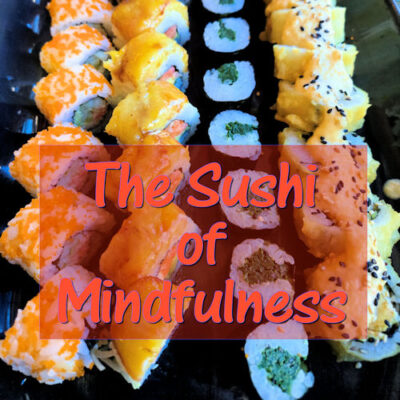
Anyway, we walked a bit and ended up choosing to have lunch in a Japanese restaurant. Lisa would not even look at the sushi that Dar and I were having, let alone try a piece. She swore up and down that raw fish would never cross her lips.
A decade later we took Lisa out for dinner. At a sushi restaurant in Toronto. Her choice. She quite likes sushi (and sake, if truth be told.)
Here’s the first point. At 16, Lisa did not like sushi. At 26, she did. Lisa’s original stories about sushi (“I’ll NEVER eat sushi!”) are obviously meaningless. She didn’t like sushi, until she did.
Which is mostly the way it actually goes, for everything. Think bike riding, driving a car, sex …
And of course, it goes both ways. Things I love (think ex-partners) can turn into things I hate. And here’s the hard part:
The sushi is the same throughout.
The partner is the same, throughout,
The sex act is the same, throughout …
What changes is how we describe it to ourselves.
Story 2:
We were watching TV after a thunderstorm. Someone got a video of a lightning strike. The bolt hit a chimney, exploded it (debris circle was 10 feet or so) and then the electricity travelled to the ground, found a pipe, slid along the pipe to the third house down, exited the basement wall, blowing a hole in it, exploding the control on the washer, and setting the clothes in the laundry room on fire.
Now I have to admit that was a new one for me.
I commented, “Holy crap! Amazing!”
But what “struck me” was the divergent reactions of the people involved.
- The guy with the laundry room fire was bemused and smirking.
- The wife with the blown chimney was “shaken and disturbed.”
- Her husband was giving tours of his backyard, taking obvious delight in the attention while revelling in the odd places he was finding bricks.
Here’s the question: what was the “correct” response?
Story 3:
In Zen Mind, Beginner’s Mind, by Shunryu Suzuki, he writes,
“A wonderful painting is the result of the feeling in your fingers. If you have the feeling of the thickness of the ink in your brush, the painting is already there before you paint. When you dip your brush into the ink you already know the result of your drawing, or you cannot paint. So, before you do something, ‘being’ is there, the result is there.”
I started painting when I was 14 or so. I’m an OK artist; used to get A’s in College Painting Classes, did some shows, but I liked photography better. After I retired, I really got into painting again.
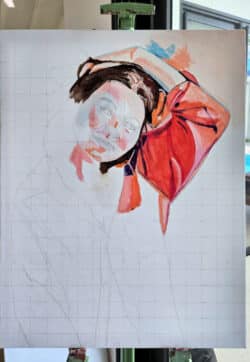
I paint mostly people — street scenes, nudes, portraits. And I am working on a new one a few days ago.
The thing is, I make tilted heads into an issue.
I’ve noticed this before. As you can likely see, I draw a grid to enlarge the image from my tablet to the canvas. I then lay out the image in pencil.
Straight head, no issue. If, however, the head is tilted, MY head and hand work to straighten lips and noses and eyes.
I know I’m prone to do it, and it happens anyway.
This morning I walked past the painting, really looked at the features, and immediately painted them out. I revisited the features and drew them in what, I hope, is correctly. I won’t know until I add paint.
So, how was I seeing the photograph, which painting was I painting, and how did I get so off track for 2 days?
It’s a mystery. Beating up on myself would be a normal reaction, but I judge it to be non-helpful. Painting out the mistakes and getting it right the second or 10th time seems more “awake.”
My point with these three stories is that our minds are trained to label and judge, when our focus might better be put on doing.
“I do not eat sushi NOW” is so.
“I eat sushi NOW” is also so.
“I will never eat sushi” is a waste of energy, and in this case, not so.
The lightning strike is a lightning strike. Now I know one can set laundry on fire, in the basement three doors away.
Is this good, bad, terrifying, interesting, delightful? No, it’s a lightning strike. The rest is just our minds, blowing things out of proportion.
My painting existed in my head until my hands did their thing. The painting is as it is, and was as it was, crooked and hopefully soon to be straight.
I can say nothing of how it will be, as it is not other than it is, right now. You may like it, hate it, or be indifferent.
That is about you, not about the painting.
This week, watch your mind, as it takes stuff in, creates stuff, directs your hands.
- Notice how often you talk about doing something, and do not do something.
- Notice how quickly your mind goes to judgement—good, bad, indifferent.
- Notice how the labels are all about you, and have nothing whatsoever to do with the thing you are judging.
Think, design, and do. Think, design, and do. Drop the pretense, the delays, and the judgements, again and again. Things are as they are, not as you judge them to be. Better to have the experience than to spend your life playing with your judgements.
Shocking, eh?
P.S. I fixed the painting!