

Dealing with Different Approaches — differences are in our heads — they’re not a part of the situation.

Psst!! Hey!!!
** Want more great writing designed to help YOU to shift your behaviour?
** Want to learn how to find, build or deepen your principal relationship?
** Want to know more about Zen living and being?
Check out Wayne’s books! (amazon link)
Or, check them out right on our site.
Just last night we were talking with friends about a trip we all took to Nicaragua.
None of us have been back since the “president” (who shall forever be unnamed) declared himself president for life. Shades of the Orange Moron.
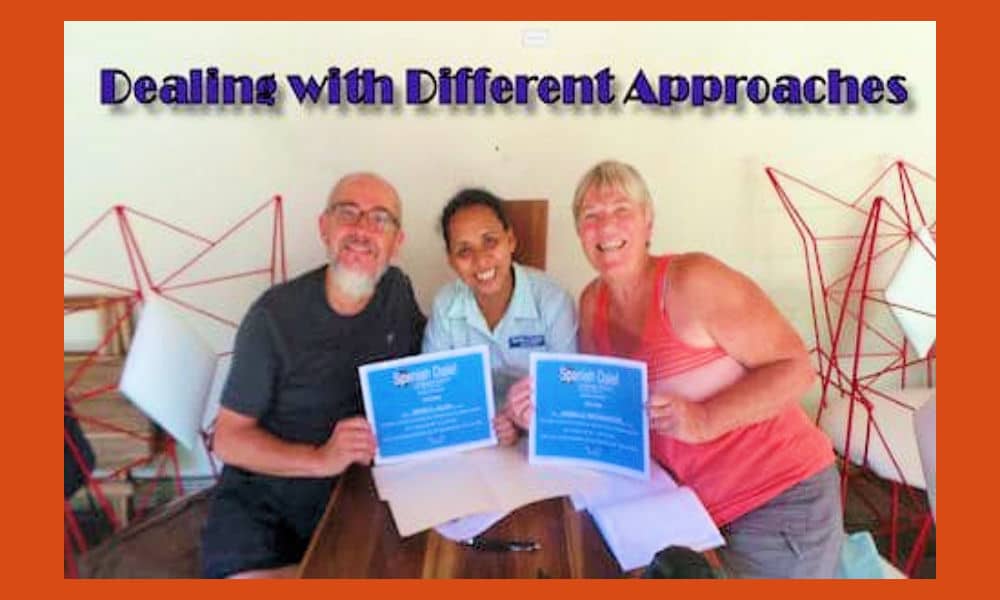
Anyway, we had a blast in Granada, Nicaragua that last trip. Darbella and I had been there before for language school. The first time, we stayed with a Nicaraguan family during the week of school.
The country is definitely different from Costa Rica, and Granada is a major city, so we learned to dodge traffic while surrounded by “mucha gente.” (lots of people.)
We’ve had a bit of a discussion with our friends about travelling and about flexibility.
I think Flexibility is the key to doing what we do… moving into a community for long stretches… like living with a Nica family while taking Spanish lessons.
As opposed to vacations, which a lot of people take… and then either stay at resorts, or gripe about how “It’s not like this at home.”
I guess this is a lot like Zen, and of course Zen makes no sense to some people. All that “nothing means anything, so just be with it” stuff.
I’m endlessly fascinated with the drama different approaches can lead to.
One of the people who stayed with our family was a woman who was entering her second year of a Masters in social work in the States. We had interesting discussions over meals about this topic…
how Flexibility and the willingness to be open to the experience at hand
is key to working through conflicts that are
nothing more than different approaches.
This fits with our endless articles concerning how, even with couples living in the same space, nothing is perceived in the same way. Different people = different approaches / viewpoints.
Dar and I notice this as we study Spanish. Her skill set differs from mine, despite our having been in the same classes / online and “real.” This can be disconcerting, especially when people forget that their way of seeing things is not universal.
It is all too easy to get caught in being right, as opposed to seeing clearly.

For example, one day we were conjugation irregular verbs in the present tense. Fun, fun, fun. The teacher tossed out poder, which means could. My mind blanked, and I couldn’t remember what it meant or how to conjugate it.
Dar blazed right through it, and, seeing me sitting there staring into the middle distance, said, “You know this,” which landed with a thud.
She then said, “puedo” which is first person.
Boom. I was into, “I’m stupid, this is terrible, I’ll never get this.”
Then I went to “Dar should have said that differently, so I won’t annoy myself…” along with me getting quiet and grumpy.
So much so that I can’t even remember how I conjugated the verb (puedo, puedes, puede, podemos, pueden, if you’re curious 😉 ) I messed with myself for 15 minutes, alternating between dumping all over myself, then blaming Dar, then blaming the teacher for picking the word.
And then I had a breath. Because, you see, the word is just a word, and the teacher picked it, and Dar conjugated it easily, and I didn’t and that’s just the way it was. I’m not stupid, and Darbella’s not withholding information, and the teacher isn’t perverse.
All of that blaming and judging is an interpretation, and it’s all me.
Every problem is like this… one person sees or does something one way, and another does it differently. “Why is this happening,” or “What’s wrong with the other person (or situation, or county)” is not the point at all.
Hard to remember when you’re winding yourself up over different approaches.
I suggest paying attention.
Noticing how you’re doing your part of the drama.
Pulling in your horns, and instead asking yourself, “Given this situation, how can I shift myself, my behaviour, and try this another way?”
Someone put it,
“Instead of blaming the other person, deal with your own anger (or games, or sadness, or frustration.”
Not hard to do, actually. The hard part is remembering to do it in the first place.