

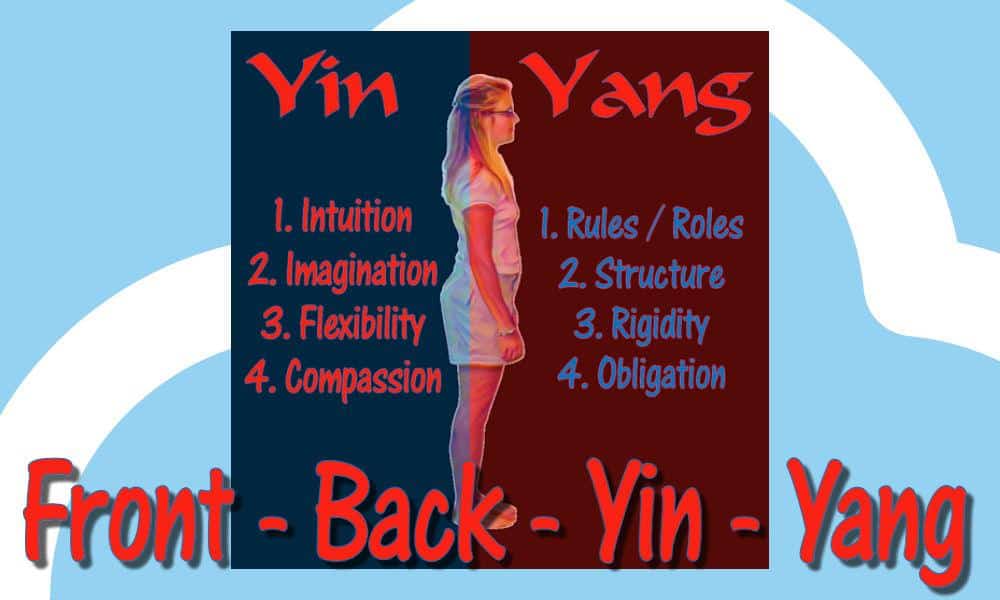
Front — Back – Yin – Yang - We have within us a range of seemingly contradictory abilities, views, and attributes. Today we have a look at how they might better play with each other.
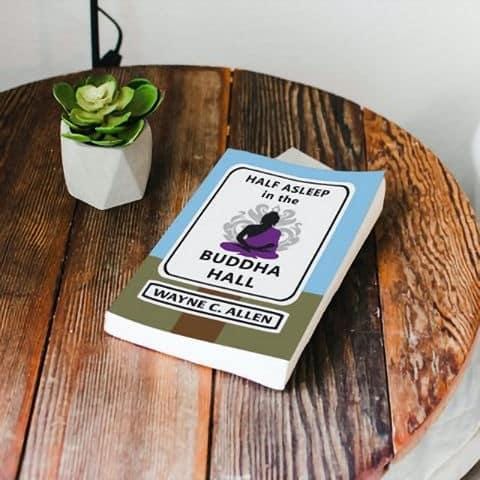
Looking for more on this topic?
Check out my book,
Half Asleep in the Buddha Hall.
My “Eastern” book takes you by the hand and helps you to find peace of mind.
Half Asleep in the Buddha Hall is a Zen-based guide to living life fully and deeply.
(Here’s a direct Amazon link)
Purchase digital versions (Apple, Nook, Kobo, etc.) from this page
I’ll get to the Front — Back – Yin — Yang chart as we go along. But first I want to tell you a story from a decade ago.
A friend of ours had, for 15 years or so, a famously wonky back. For which there was no medical reason, something that gains importance as we go along.
Anyway, she messed her back up again, as usual, by doing “nothing.” She ended up off work for several days. The Saturday came around and they invited us for dinner, with the warning that she wasn’t sure she’d make it through the meal without needing to lay down.
We showed up, and she was barely moving. They had a massage table, which, considering her back, got a lot of use, so I suggested she lay on it, and the 4 of us could talk while I worked on her back.
So, she did. And she let me know that, this time, she was sure she’d done some major damage to her back.
I checked, and didn’t feel any lumps or bulges, and said that I was pretty sure that, as usual, nothing physical was going on.
One more thing about her, and then, a bit about the chart.

She was lying face down and said that the front of her body felt much better than the back of her body.
You’d be tempted to whip out a, “Well, duh, it’s her back that’s out” kind of response to that, but bear with me.
As she spoke, and as I worked on her, I had a flash that there was something about yin vs. yang energy that I was missing; that’s just how my mind works.
Anyway, all the way home I “mulled.” Late that night, back home, I couldn’t sleep.
I fell into one of those dreaming without dreaming states and imagined myself writing a book about what she said. And the red and blue person (see the chart above) played a prominent role and the little move that was running in my head.
The internal exploration I was doing had everything to do with Front — Back – Yin — Yang.
Now, if you’ve been reading my stuff for any length of time, you’ll know I’ve written about this topic before. Assuming you’re reading this on the website, you can search for Bodywork and Yin / Yang articles.
But here’s the weird piece… I’d never really thought about yin and yang as it acts as a metaphor for the front / back of the body.
So, I had an “of course” moment = Front — Back – Yin — Yang
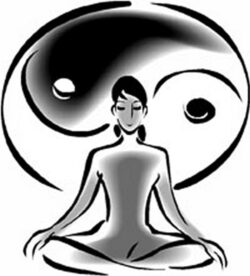
In Chinese thought, things seek balance. This is so with the meridians, with the energy pools (Dan Tian) and for the Taoists, with Yin and Yang.
The symbol shows this by the equal amounts of the two colours. But more importantly, balance is shown symbolically by the black circle in the white side, the white circle in the black side.
This is the closest an unlabelled illustration can come to making the point that neither polarity is “better” — “better” is both / and, not either / or.
You might say that “The West” is yang, and “the East” yin—specifically because the West loves “either / or,” the East “both / and”—something Buddhists call The Middle Way.

In the West, the expectation is that someone or something is always going to figure out specifically what is up, and what is up is going to be clear-cut and obvious, once the expert declares “truth.”
In the East, things are not so clear.
From the time I’d met her, my friend had searched for a medical reason for her wonky back. Only, here’s the issue with that. Her back is perfect. OK, maybe not perfect, but not the cause of her pain.
X‑Rays? Negative. Physio? Nada, or rather, “It’s coming from your pelvis.”
For more of this story, and specifically her pelvis, see “My Husband and My Pelvis”
So, what’s another story about her pain?
Things tended to go off the rails for her when she was stymied. When her emotions got triggered.
And I’ve got a million examples of that happening—blocked emotions leading to non-physically-caused pain. I’ve seen it with friends, past clients, myself, Darbella.
And that’s where the above chart and red / blue person comes in handy. Or so my non-dreaming dream suggested. Have another glance.
As an overall metaphor, (and that’s what yin / yang is… a metaphor) try this: the yang (back) side of the body is tasked with control. Because control has to do with rules and roles, the yang side fears flexibility.
Yang 101 — Beliefs
- Without control, we “wouldn’t have a leg to stand on.”
- The yang side warns us to “watch our butt,” so no one “stabs us in the back.”
- Forces us into military posture, so we can “(wo)man up.”
- Gives us the “spine” we need to survive.
- Helps us to “shoulder our burdens.”
- Keeps us from “sticking our neck out.” And emphatically, the Yang side
- values “the right answer” (party, religion, sex, philosophy, etc.)
- You remain “in the right” by standing up for yourself, and you do that by speaking your mind.
That last one is my favourite as weird ideas go. Think MAGA. Imagine what the world would be like if we “spoke our hearts.” But I digress.
So, imagine a person, caught in rules and roles. They’d want to be a good son / daughter, father / mother, wife / husband. As if anyone has a clue what that (what “good”) means.

Take “good wife.” Can you see that the way “good” is defined has everything to do with:
- where you were born,
- what your religious affiliation is, even
- your politics?
And haven’t you heard multitudes going off on this one, absolutely convinced that their view of how a “good wife” behaves was the correct one?
That’s Yang.
But please, don’t get your back up… 😉
Which is, actually, what happens physiologically, when yang gets agitated.
Another friend of ours was talking about “doing the right thing.” She said, “I’m doing it for my relationship and family.” Her back straightened, and her eyes glared a bit.
I said, “But… what about you?“
She clutched her chest (pressed her yin-heart) and got all weepy. “I don’t know…”
In my non-dreamy dream, I pictured my friend with the sore back tied to the tree of rigid beliefs, trying ever so hard to stay still (“upright”), be “good,” not make a scene, be “seen and not heard.” (This is how she was brought up.) I saw her struggling not to struggle with being a role instead of a person. Her back was practically locked up from this effort.
Struggling against what, you ask? Against herself, or better, against balance.
I guess I helped her a bit that evening, because her back let go a bit. A few days later, Darbella and I saw her again, and she actually danced / skipped to the door. That’s Yin.
Yin 101 — Activities
- It’s “dancing your feet off,” while declaring “I’m flexible!”
- It’s “shaking your booty,” while “moving to the rhythm of life.”
- It’s opening your heart to the situation in front of you.
- It’s opening your arms to give and receive caring and compassion.
- It’s tasting and savouring the richness there in front of you.
- It’s speaking your heart, while clearly seeing beneath the surface.
- And emphatically, it’s thriving on uncertainty.
My Yang-burdened friend, tied to the tree of beliefs, is torn. Her front wants to dance and sing, to reach out with compassion, to intuit a deep and vibrant life. Her back is working tirelessly to keep her safe by “making her” rigidly follow rules and roles.
Others I know are the opposite — Yin personified — flitting around like bumblebees, never landing, and therefore never really accomplishing. They’re dragging their Yang side around, while spouting spiritual platitudes… and Yang is screaming for contact with the ground.
The key here: It’s not one or the other. It’s both, in balance.
And that kind of balanced living comes from consciousness and presence.
There is no “one, right way” to be, although there is often a “right” answer or behaviour, right now, in this moment, this situation.
The answer to the dilemma of living is found in refusing to accept pat answers, either from others, or yourself.
We all tend to lean a little (or a lot) off plumb—as in, our tendency is either toward Yin or Yang. But it’s only a tendency. It becomes real only when we let ourselves fall for the bull we so elegantly shovel.
We can, on the other hand, ask ourselves, “Given who I wish to be—whole, wholly me, clear, conscious—what action (including doing nothing) is the most appropriate, right now?
The next action almost always will lie on the centre line between the two poles, and will be an elegant dance.
Or a non-dreaming dream. The mind boggles.