

- The Prison of Body Resistance — Set Yourself Free Series
- Prisons of the Spirit — Set Yourself Free Series
- The Prison of Imagination — Set Yourself Free Series
- Breaking Through Beliefs — Set Yourself Free Series
- True Intimacy — Set Yourself Free Series
- True Liberation — Set Yourself Free Series
- Learning by Letting Go — Set Yourself Free Series
- Unbinding — Set Yourself Free Series
- Dropping Manipulative Games — Set Yourself Free Series
- Passionate Engaging — Set Yourself Free Series
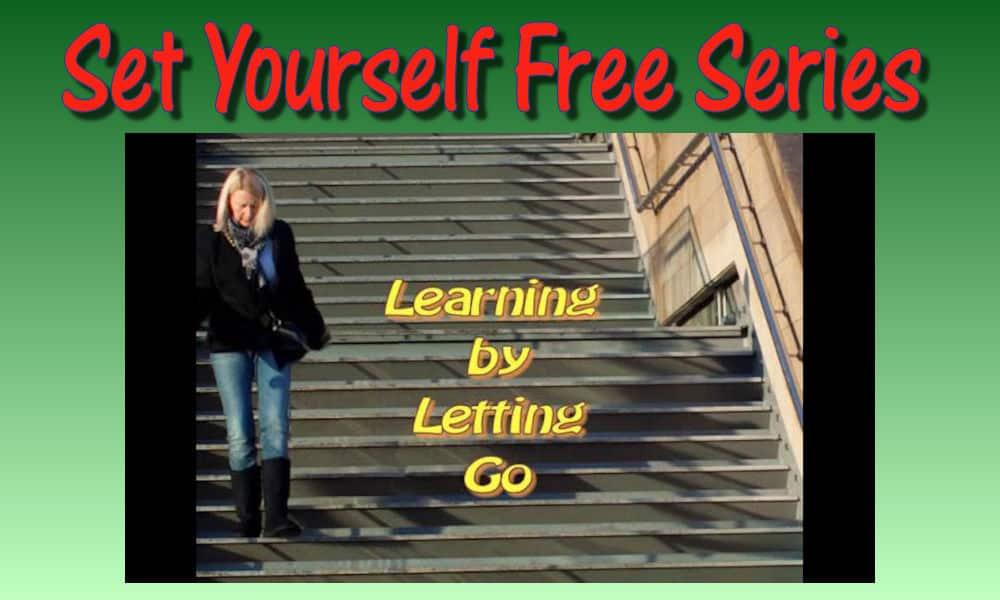
Learning by Letting Go — we need to work through our issues, and come to a place of understanding and elegance. Sometimes, when we reach that place, some letting go is required.

Psst!! Hey!!!
** Want more great writing designed to help YOU to shift your behaviour?
** Want to learn how to find, build or deepen your principal relationship?
** Want to know more about Zen living and being?
Check out Wayne’s books! (amazon link)
Or, check them out right on our site.
This week’s question:
“So could I please ask you to talk about divorce, talk about healing and recovery from a broken dream, how it could be a chance of growth and development…”
I was checking out my bookcase, and rediscovered a series of books on Morita therapy — a style developed in Japan. The style embraces both Western approaches and Zen Buddhism. The book I picked up is one of several by David K. Reynolds, titled, Playing Ball on Running Water.
In Morita Therapy, clients are like Zen students; as students, they are provided with exercises and descriptions we might call “functional understandings.” It’s a truthful way of looking at therapy — the person is in therapy to gain a better understanding and a different approach to how life works.
Anyway, I was browsing the book, reading sections I had highlighted, and came upon a section relevant to “manipulation.” There was a story about a woman was angry over her husband’s drinking and smoking — and had learned through Morita therapy that we cannot control other people.
– So, when she began to refuse to buy beer for her husband on her shopping trips, he said nothing, but she felt guilty about her efforts to influence his drinking.
Her misunderstanding was in confusing effort with results. There is nothing wrong with trying to influence others. We do it all the time. This book is my attempt to influence the way you think about certain things, and to influence what you do. Almost everything we say is an effort to influence others, at the very least to influence them to listen to us. Trying to affect other people is a natural, everyday aspect of human life. There is nothing inherently wrong with it, however concealing these efforts, using physical force, or using our influence to obtain certain goals may be wrong in many circumstances. On the other hand, to be attached to or to be obsessed with the effects of our actions to influence others is a mistake. Like any behavior, actions to change another person should be undertaken with full attention and wholeheartedly. But then we must leave it up to the person to decide whether to change or not.
I am indifferent to whether you understand and accept the life principles in this book. Some of you will find them intriguing and immediately beneficial. Others will reject them out of hand. That is your business. My success or failure lies not in whether I have convinced you of the wisdom of Morita’s method, but in the quality of my presentation. If I have written with full attention, as well as I can, then the outcome is of interest to me but not crucially important.
It is the same thing for the young housewife. She is quite appropriately concerned with her husband’s problem. Smoking and excessive drinking are very likely to shorten his life. She has every right to attempt to influence his habits. She has been quite clear with him about her purposes. But there her attachment must stop. Whether he stops drinking and smoking is his concern. She is personally interested in the outcome of her efforts, but she must not judge them in terms of the outcome. She does need to know if he stops in order to know whether she needs to continue trying to influence him to quit. But she must leave up to her husband, and him alone, the decision about how to respond to her behavior.
She cannot control him; she must not commit herself to controlling him. But, for her part, she is responsible for doing what she can to achieve her purpose. Again, her purpose is not to control him; her purpose is influencing, not the resultant effect.
David K Reynolds, Playing Ball on Running Water, Pgs. 30–32″
Everything I write is about influence — it’s about me encouraging you to begin and continue a most interesting walk.
My responsibility stops with my writing. I influence through what I say and do, and you choose to respond or not.
As to marriage, relating and divorce, the un-learning is: we must not, as adults, spend our lives trying to “make” other adults understand, change, behave, love us, whatever.
I can’t stress this enough: You must not treat adults like kids.
You have a right to your opinions, and you have a right to express your needs and wants (to influence.) You have no right to demand that others do your bidding. And vice versa.

Marriages fail because the participants cannot solve the “manipulation power struggle.” Both parties want the other to cave in, and neither party is willing to budge.
The fundamental differences become increasingly apparent, and are not seen as “interesting,” but threatening. This progression from fantasy to reality happens in every long-term relationship, as the partners move from falling in love (romance) to conflict.
Once we’re in “conflict,” we begin to see what Reynolds is describing, above: the confusion of effort with results.
Let’s look at marital conflict. And, let’s agree on one other thing: no one on this planet, repeat, no one, was brought up like you. Not your siblings, not your neighbours, and definitely not your partner.
Despite this, I know you desperately want to believe that everyone sees the world just like you do. You assume when you spout some gem of “wisdom,” others are disagreeing or resisting out of spite:
“Why can’t I wear a skirt that starts 3 inches below my navel, with a hem up to my crotch? All my friends are doing it!“
And dad replies, “Not in my house, son!”
You must believe that everyone thinks the same, because that’s what you keep saying, as you fight,
- “Everybody knows…”
- “No one else has to put up with…”
- “All the other wives (husbands)…”
And all of this “knowledge” you think you posses is based upon one thing: what you’ve learned to be comfortable with.
You were brought up by your parents and “tribes” with a ton of generalizations.
While I seem to be hammering the same nail, what I’m trying to get across is this: there is no “one way” to see anything. I have my way of seeing and being, and you have yours. We can talk, and you can hear what I say and reflect upon it, and maybe even you’ll choose to agree with me.
Even if you do, however, how you understand and apply what I say will be absolutely unique to you.
Now, if I go into a relationship not understanding any of this, what I’m going to do is to assume that my way of understanding how to “couple” is not only the “right” way, but the “only” way — the universal way.
Thus, “Everybody knows…”
Funny thing, though. My partner believes the same thing about his or her world view. “Everybody knows…” The conflict stage in relationship is two people, each of them thinking they are “right,” desperately trying to get their partner (the only person on the whole planet that’s out of step) to change.
Anger in relationships is directly attributable, every time, to both parties demanding change from their partner, and not getting it, while absolutely refusing to change anything about themselves..
Once you reach the conflict stage, several forks in the road appear. in 95% of the cases, there are three options that arise:
- staying and fighting,
- leaving and divorcing, or
- staying but shifting one’s perspective to apathy.
The 4th option, chosen by maybe 5% of couples, is to stop trying to be right and to simply accept your partner as he or she is. And then, with mutual agreement and humour, to, as Reynolds says, above, exert influence without attachment to the result.
For many of of us, it may take more than one “marriage” to “get” this idea. Unreal expectations lead many of us to get married for all the wrong reasons. Those of you that have read my books and freebies will know that I have been married 3 times, briefly in University in the 60s — ah, the life of a hippie — and for 9 years in the 70s to early 80s.
Prior to marriage # 2,” I remember deciding to marry her because she looked good and I’d invested a year of time into the relationship.
This despite my having ended our dating relationship 3 times, each time thinking “We’re not even remotely compatible.”
I married her anyway, thinking, “There’s some stuff about her that I like, and the rest I can get her to change.”
When we reached the conflict stage, I took us to therapy, and she said, “There’s nothing I would change.” I was angry, she was apathetic. There, we stalled.
Finally, I decided that “stuck” wasn’t cutting it for me. Settling for an apathetic relationship lost its appeal. I made the decision that staying stuck for 50 years and then dying was not exactly the most interesting way to live my life. So, I ended it.
I was in therapist training when all of this happened, and I decided that I wanted for myself the kind of relationship that I was encouraging (and teaching) my clients to have — one of mutual respect, curiosity, non-manipulation (but lots of influencing!) and intimate dialogue.
I decided to find someone who wanted to commit to self-exploration as she related with me (tall order, I know…) and.. I found Darbella!
Darbella and I have known each other since Sept. of 1982 — (Zowie, 42 years this past September!!! An amazing and fun ride, one I’m grateful for each day…) and this is her first marriage. Hmm. Maybe she should be writing this article…
We agreed early on (date one, actually) that we would follow the 4th option, and work through our issues by learning about, accepting, and understanding ourselves, as opposed to trying (and failing) to change each other.
So, in answer to the question of the week, divorce, in and of itself, teaches us nothing other than how to exit a bad relationship.

The learning comes afterwards, and perhaps also in the process of leaving.
The lesson I learned was that attempting to change another person into the person I wanted to be with is the height of arrogance.
To choose a partner who already is who I want to be in relationship with (who, as I see it, is walking a similar path) is wisdom.
And as I wrote above, the key to escaping conflict is to work through the power struggles and conflict together, noticing when either of us is trying to force the other to change.
We notice, we talk about it, and we accept, ever again, responsibility for ourselves and ourselves alone.
I learned that I could find a partner who would accept me as I am, for what I am, and in that relationship I found the courage and the strength to simply be that person.
When I jam myself up (and, of course, I still do, occasionally ) Darbella just laughs and waits until I get over myself. And I provide the same non-judgmental support for her.
We influence, without attachment to the result. For me, I have learned patience and I have faith in grace.
And you know what? I wake up each morning and go to bed each night thankful, both for the chance, day by day, to meet myself, coming and going, and especially, each day I am thankful for Darbella.
For me, she embodies the depth of the grace of the universe. That which is fervently sought is often found. That which is required appears when one is ready. We walk our solitary paths together.
For me, that’s enough.