
- Letting go of Assumptions — Letting Go Series
- Letting Go of Enchantment — Letting Go Series
- Letting Go of Self-Indulgence — Letting Go Series
- Letting go of Techniques — Letting Go Series
Letting go of Assumptions — most never explore their baseline assumptions, and end up living on autopilot
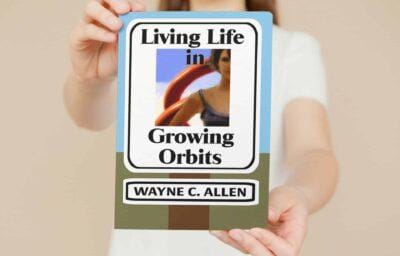
Living Life in Growing Orbits is our workbook.
52 weeks of daily exercises designed to help you figure yourself out.
Check out Living Life in Growing Orbits on our site.
Direct link to Amazon
Purchase digital versions (Apple, Nook, Kobo, etc.) from this page
Back in the 70s, many were looking for another path. EST, Encounter Groups, Meditation Groups—and a common idea.
You Have to Develop a Self
Before ‘Losing’ Your Self.
The “Losing” Part Does Not Happen Naturally!

The creation of a personal and social identity (this is not the self—this is the ego identity) is the work of the first 16 years or so of life.
(If you think about the average 16-year-old and her monumental lack of knowing who she is and how the world works, you will get my point.)
Creating a personal and social identity involves learning live in 3D, in a physical world. You learn how to ‘operate’ people and things—for example, how to turn on a stove, how to address others, how to act in relationship to others.
This is a mechanistic model, and is decidedly rules based. It is good to know, for example, that stepping off the top step of a ladder typically leads to a fall.
The Ego Project
The first 16 years is all about what I call the “Ego Project.” It is important to note that the personal ego created in this process is self-aware but not self-reflective.
I know that I am I, but
I do not really know who ‘I’ am.
When asked about himself, the average young adult might recite a list of characteristics— height, weight, age, sex, etc. He might identify with a particular philosophy, political direction, or religions stance, or other belief system.
Example: what is a car? Most list characteristics—engine, brand, colour, horsepower—but this fails to identify the car’s essence—its ‘car-ness.’ Thus, the car’s car-ness is a being-state that cannot be reduced to parts or characteristics.
In Buddhism, these sorts of lists fall under the category of maya, or illusion. The person holds on desperately to definitions, for fear of the emptiness that seems to be right under the surface.
Humans at this stage exhibit one common characteristic—they suffer. We feel this suffering as a pervasive sense of unsatisfactoriness.

The cause of suffering is grasping.
Grasping comes in three flavours—attraction, repulsion, and indifference.
For our present discussion, you can think of grasping as clinging tightly to your personal definitions, beliefs, and prejudices (pre-judgements.)
Clinging is the young adult’s desperate tactic to avoid facing the maturity of letting go.
It is Hard to Move Past your Conditioning
It is important to remember that our parents and tribes teach us to cling to tribal assumptions for a good reason—they want to socialize us. The unfortunate part is that most reach adulthood thinking that this is the only way to live and to be.
Our culture has failed abysmally at teaching people to use personal and social identity as a tool. Without learning this, young adults are doomed to grow old as nothing more than the totality of their assumptions.
The development of a True Self
Typically, there are bountiful opportunities to shift our perspective. Usually, they come as the result of a tragedy or crisis. There are then two choices.
- We defend our conditioning in the face of its failure (95% choose this approach), or
- we let go by paying attention to the programming of our minds, with the goal of making choices as opposed to unthinking reactions.
Watching Your Mind
How you appear to yourself (your ego-image) is, if you watch, a mental process. In other words, how you feel about yourself is an internal evaluative process.
It is not caused by external situations
or the judgements of others.
What happens is that you (often arbitrarily, or out of boredom), select some aspect of your history, some characteristic of your ego-self, or you select your whole self, and then apply one of the three ‘grasping’ categories. You like yourself, you hate yourself, or you are indifferent.
If you watch, you begin to see that your mind is selecting aspects of yourself (or inventions of your mind—I have one friend who is a triathlete and often thinks she’s fat… because her father thought see was fat…) and adding an interpretation.
How something appears, then, is clearly not fixed in stone. How something appears has everything to do with how I choose to describe it. And then, how I judge it.
It is not possible to stop this evaluative process.
It is programmed into our cellular structure. What is possible is to shift our identification with the stories, descriptions, and judgements. This process begins with reflective questioning.
Ask Yourself this…
Go inside, and speak to yourself. Ask:
- Is this belief helping or hindering me?
- Is what I am doing helping or hindering me?
- What would another, more helpful story and action be?
- Who is it that is asking me these questions?
This is not a popular path
Those who choose it ask these questions, and others, on a very regular basis. The purpose of the questions is to challenge the necessity of hurting yourself with your judgements.
Remember, the stories you react to will pop up until you curl up your toes. The stories and the facts of your life ‘just are.’ The optional piece is torturing yourself. I call this bashing yourself in the forehead with a hammer.
What to do?
Get up, get out, go for a walk, meditate, study yoga or tai chi, do Bodywork, get a life.
Sitting there stewing is mental abuse, and you’re doing it to yourself. Here’s a hint: never, once, did your internal torture do a single thing to change things in the physical world.
Thinking changes nothing. Acting changes everything.
After 50 years of this work, I still torture myself over the same sad stuff. Briefly. I also notice what I am doing and give myself permission to shift my thinking and my ‘doing’ to something else.
This, and nothing else, is the essence of letting go.