
Mindful living is passionate, engaged living. This article looks at being present in your body, embracing who you are, and making the choice to live fully and completely through mindful living. The challenge: letting go of internal and external pressure to stay the same.
When you commit to mindful living, you prioritize your mental health. It is vital to incorporate mindful living practices into your life.
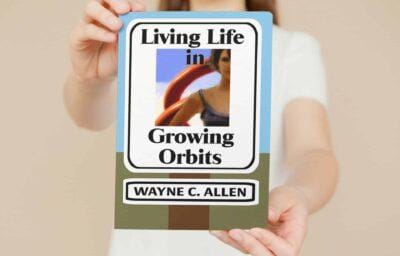
Living Life in Growing Orbits is our workbook.
52 weeks of daily exercises designed to help you figure yourself out.
Check out Living Life in Growing Orbits on our site.
Direct link to Amazon
Purchase digital versions (Apple, Nook, Kobo, etc.) from this page
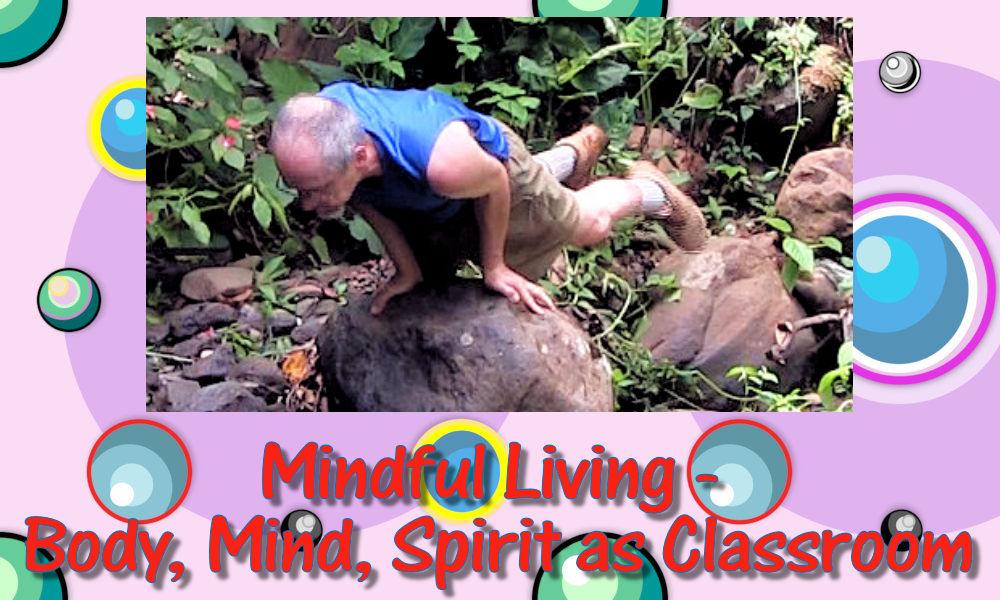
Body, Mind, Spirit as a Mindful Living Classroom
Last article I concluded with a long list from Sheldon Kopp. As I was contemplating mindful living, I caught sight of the bottom end of the list, and especially:
38. We must learn the power of living with our helplessness.
39. The only victory lies in surrender to oneself.
40. All of the significant battles are waged within the self.
41. You are free to do whatever you like. You need only to face the consequences.
All 43 items in the list are interrelated, and part of the ‘helpless’ (# 38) idea is that we always work from a place of insufficient information (# 33–35).
By adopting mindful living practices, we can better navigate our internal landscapes and become more aware of our emotions and reactions.
First Exercise: Identifying Patterns
Think of some habitual behaviour you perform, that always gets you in trouble. See if you can think past the blaming (i.e. “s/he made me do it,” or “it’s the world’s fault,” or ’ ”it’s in my genes”) and just notice the pattern = “A” happens, and I always, automatically do “B” behaviour, which leads to “C“rappy results.”
Now, wonder with me for a moment. Why do you continue to do what does not work?
Don’t give up on this question. I am not suggesting you feel bad or try to justify what you do. Just clinically and clearly ask yourself: “Why, when “A” happens, do I always do “B”?”
One of two things will happen. You’ll either have an insight about something that happened in your distant past that became the catalyst for the behaviour, (Kopp: # 25. Childhood is a nightmare), or you’ll be completely puzzled, unable to find any reason, let alone a good reason.
In either case, once the blaming and excuses stop, you’re left with nothing upon which to base your present behaviour.
The Next Dilemma
Mindful living begins with this subtle recognition:
I am helpless to change others or the world, and I never have all the answers.
Which, once you really get it, is pretty powerful.
It’s powerful because you can stop yourself from wasting time doing what will never work, and you can get to working on your self.
BodyMindSpirit Work
Your body, mind, and spirit is the only classroom you have a hope of succeeding in.
For those of you that are heavily invested in changing the world, ending poverty and disease, etc.—good for you! Do what you can. Every significant change has come from the work of individuals who first worked on themselves. In other words, change in the world comes from personal effort and discovery.
BodyMindSpirit work (BMS) is, for me, best captured in the concepts of Zen and mindfulness. (Surrendering to self (Kopp # 39) is all about accepting that the only reality you have is the one inside of you.
What goes on inside of you and how you spin your life is uniquely yours. As in my suggestion about thinking about your habitual behaviours, the goal of BMS work is to become conscious of your process.
This is simple/hard.
Next time you get angry (or have another profound experience) try this: instead of blaming and finger pointing (Kopp: # 37 — It is most important to run out of scapegoats) and thus detaching from your anger, stop and have a breath.
Be present with the feeling of your anger. Say, to yourself or aloud, “This is anger.” Then, “I am angry.”
Once you have named and owned the feeling, find a safe place to “be” your anger. Climb into your bed and pound your pillow. Go out to your car, roll up the windows, and scream.
Many New Age wimps think the game is all about walking around humming “Om” and smiling. Crap. BMS work is all about being completely in your experience, without blame, without misdirection, without excuse.
When we do this, we find that our emotions and thoughts flow through us like water in a fast-moving stream.
There is nothing real or permanent about any of it.
To continue with anger for a minute longer: people fear anger because they mostly have seen it directed at others, or have seen violence. We are speaking here of self-responsible anger (and self-responsible everything…) that has limits and controls. When we teach our clients this, the rules are:
- direct the anger at an inanimate object (a pillow, pad, etc.)
- Don’t touch anyone without permission
- Don’t break anything.
- Set a timer for 5 minutes, and really go for it.
The Pleasure of Internal Battles
The concept of an internal battle is this: internal work is not about ‘letting it all hang out.’ It’s about self-discovery that’s under your own control.
Most people have no control. So, they blow and spout and steam and run in repetitive circles.
Mindful living is about living focused on you and your ‘stuff’—you and your choices. And to accept that all of it is ‘you.’
Once you get this, you can dig even deeper, and you’ll find additional resources and new ideas for living out your life.
Remember, thinking you can keep doing what you are doing and get different results is childish.
Living new, Amorous Adventures
A friend of mine posts her ‘status’ regularly. Yesterday, she posted a line from her Chinese horoscope:
I am having my heart torn between stability and the need to live new amorous adventures. (Chinese horoscope).
Notice how this horoscope perfectly captures the dilemma of life. You can either try, desperately, to cling to stability (an illusion, as everything is always changing) or you can passionately live life.
I wrote to her that my experience of her and her self-made dilemmas was perfectly captured in this horoscope.
As is true for all of us.
This IS the dilemma

We’ve been conditioned since childhood to desperately cling to stability, so we make it difficult to let go — to shift. We scare ourselves.
As each thing ‘comes up’ for us, there is a choice. Do I ‘behave myself’ and do what ‘mommy and daddy’ what me to do, or do I take a risk?
This is not to say that embracing a life of ‘living new amorous adventures’ will be easy, or acceptable.
Because most people fear change, and see exploration as threatening, there will be outside pressure to conform, and internal pressure to be a good boy or girl.
So, we go back to our initial exercise, rephrased:
Second Exercise: Dancing With Your Patterns
Think of something you want to experiment with, something that has a real ‘charge’ for you. (Think of it as a new amorous adventure.) See if you can think about what stories you tell yourself to:
- stop yourself from having the experience,
- experiment with it only in your imagination,
- or experiment only at a glacial pace.
Whatever.
Now, wonder for a moment. Why do you continue to do resist diving right in and having the experience?
Don’t give up on this question. I am not suggesting you feel bad or try to justify what you do. Just clinically and clearly ask yourself: “What am I doing here? Why am I behaving in a way that is contrary to having this experience?”
(Hint: for many, it’s “What will people think?”)
One of two things will happen. You’ll either have an insight about something that happened in your distant past that became the catalyst for the behaviour, (Kopp: # 25. Childhood is a nightmare), or you’ll be completely puzzled, unable to find any reason, let alone a good reason.
Once the blaming and excuses stop, you’re left with nothing upon which to base your present stalling behaviour.
A Small Reminder
Now, I want to quickly say that Kopp reminds us: # 41. “You are free to do whatever you like. You need only to face the consequences.”
North Americans especially do not like consequences. Changing a chargy behaviour has the potential to stir up all kinds of interesting stuff. Mostly, there is the potential of someone around you getting their shorts in a knot.
So, you’re right back to: “I think I’ll live my life as a good boy/girl, and do what others want me to do.”
Besides, the unknown is so… scary.
Well, have a look at your life. If you love it exactly as it is, keep doing what you’re doing. If all of it or aspects of it aren’t working, you must pro-actively change something.
Mindful living. There is no other option.