
- Is-ness: Life is not as it is. Life is as you are — The Myths Series
- The Myth of Absolute Truth — The Myths Series
- The Myth of Right and Wrong — The Myths Series
- The Myth of the Threat of Change — The Myths Series
- Unraveling the Myth of Shoulds — The Myths Series
- The Myth of Fairness — The Myths Series
- The Myth of No Consequences — The Myths Series
- The Myth of Altruism — The Myths Series
- The Myth of Easy — The Myths Series
- The Myth of Scarcity — The Myths Series
- The Myth of Limitations — The Myths Series
- The Myth of a Soulmate — The Myths Series
- The Myth of Sex Equaling Intimacy — The Myths Series
- The Myth of a Self — The Myths Series
- 5 Ideas About Compassion
The Myth of No Consequences — the consequence, or result, is caused by the actions preceding it, 100% of the time
Of Wayne’s many books, the one closest to today’s topic is: This Endless Moment

This Endless Moment
An excellent guide to life and living.
Learn to focus your attention of who you really are.
Purchase all formats from Amazon
Purchase digital versions
(Apple, Nook, Kobo, etc.) from this page
In Buddhism, there is endless talk about the myth of independent origin. Usually, it’s put the other way around: the reality of dependent origin.
Briefly, one of the marks of Buddhism is its insistence on the inter-relatedness of all things. This means that no matter how unique and “singular” an event seems, it is tied into a long string of other things.
Here’s a Soto Zen Gatha that expresses this (especially in the first paragraph)
First, seventy-two labors brought us this food. We should know how it comes to us.
Second, as we receive this offering, we should consider whether our virtue and practice deserve it.
Third, as we desire the natural order of mind — to be free from clinging — we must be free from greed.
Fourth, to support our life, we receive this food.
Fifth, to realize the way, we accept this food.
First, this food is for the Three Treasures.
Second, it is for our teachers, parents, nation, and all sentient beings.
Third, it is for all beings in the six worlds.
Thus, we eat this food with everyone. We eat to stop all evil, to practice good, To save all sentient beings, and to accomplish our Buddha Way.
OK, so here’s the kicker. The idea of dependent origin also applies to each of us. We are not unique, nor self-sufficient. We are the result of a long stream of genetics and choices.
- First, we are the result of our genetics. We were made in the cauldron of relating and mating.
- Second, we have formed ourselves as a result of the choices we have made regarding events of our life, much as a potter forms a pot on a wheel. We are what we have made.
- We therefore are the result of the above; we have no independent being.
What this means is that we are the consequence of our choices.
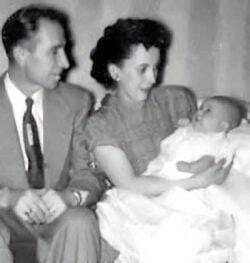
Let us consider the lump of clay that is a newborn. The child is a genetic amalgam of both parents, who each are an amalgam, and back and back to when we climbed down from the trees.
Infants are hard-wired, for example, to nurse — to “latch on.” This is one of many instinctual behaviours. Some brain scientists would argue that mood and temperament are equally hard-wired in — our baseline view of the world, for example.
The rest of who we “be” is learned.
Our parents and tribes set us on a path; we — little bundles of “no-nothing” autism — are given structure, explanations, and examples. Each of these things is dictated by our culture (i.e. most of us eat what our culture or religion eats — we didn’t choose this — we absorbed it.)
Then, there are the quirks of our parents.
From within the allowable parameters of each child’s culture, parents have the freedom to tilt us in particular (peculiar) directions. They promote certain aspects of our arising personalities, and block others (or at least try to.)
Because this structuring is happening to us from infancy on, we tend to believe the story we are told, and at some level, become the people our parents want us to be.
So, what about no consequences?
When we are children, consequences are typically expressed in the form of punishments. “You hit your sister, you’re having a time out!”
A story: I, age 3 was at the chiropractor’s, wouldn’t stop acting up. I think I did an entire vaudeville routine. Mom, non-violent mom, warned me that there would be consequences if I didn’t stop. I didn’t.
We got home, my butt and I met the wooden spoon. Consequences.
Where this went off the rails for me is this: I never really “got” that my behaviour led to the application of the wooden spoon. I got it intellectually, but never got past the “It’s not fair!” response. To repeat:
- As kids, when we were punished, we learned a skewed view of consequences . We’d break something and get sent to our room. Most kids have trouble thinking, “Gee, I broke that, and this is a fair consequence.” No, we come up with, “It’s not my fault. I didn’t know better.” Or, we go to: “They don’t love / appreciate me.”
- And then, because something else will always happen, we learn to lie. We blame others. “I didn’t do it, Tommy did!”
- If no one else is around, we’re limited to “It wasn’t me!” or “It was an accident. I shouldn’t have to pay the price of an accident!”
Kids hate consequences. And most kids never grow up.
Despite the wooden spoon, my upbringing was positive; I would now say overly-positive. My mom especially would intervene so I wouldn’t fail. As a result, I got all the way to University thinking I could do any dumb thing, and somehow, magically, I’d get what I wanted.
And then, because mommy wasn’t there, I started experiencing consequences. I handed in a paper late, I got a bad grade. And low and behold, my profs didn’t care if I was “supposed to” get a good grade.
I slowly started to figure out the connection between “this” and “that.” And I do mean slowly.
This “endless learning” thing is another thing that does not set well with “modern” people. So it becomes a compound problem — the game is a game of a lifetime, and where you are and who you are is about where you’ve been and what you’ve done.
Back in my counselling days, I briefly worked with a guy who was the spouse of a long-term client. He came in twice. He also had a PhD, which says something — I’m not sure what. I never had time to learn how he developed his world-view, because, only two sessions.
But his was very much the life of Peter Pan — the boy who never grew up.
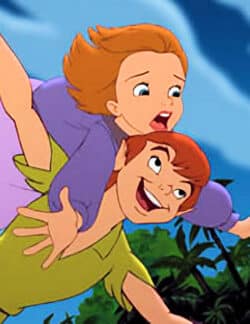
He fervently believed that Never-never Land was real – that he was destined for greatness, bliss, endless great sex, and no issues — and all of this would happen with no effort on his part. All of this would happen no matter what he did.
He loudly declared that he knew for a fact that relationships were easy. All you had to do was meet the right person and there would be no problems, great sex and nothing to resolve.
I tried to help him to understand that his beliefs and behaviours were the cause of his dilemmas, but he couldn’t see it. He really believed in Never-land.
We briefly decided to talk about marriage and sex, as this was really on his mind. He was in his 50s when I saw him, and was baffled that his vision of “how things should be” did not match with “how things are.” He told me that he wasn’t happy in his marriage with my client, because “her” issues kept arising and “bad things kept happening.” Oh. And the sex was “mediocre at best.”
His marriage to my client was his fourth marriage, and he’d had several relationships on the side during all of them, and had yet to find “Ms. Perfect.”
I again tried the, “It is your beliefs that have led you to this place,” but he wasn’t buying it. Who he was and where he was was not his responsibility — he had no responsibility. All the women he chose and lived with mysteriously ended up to be somehow “wrong.”
Peter Pan-like, he left therapy, and left Canada to search the world for “the perfect relationship, which for him meant no consequences, no hassle.”
It’s all so easy — be a kid, look around, find someone to blame, and to ignore that where you are “now” is exactly and precisely where you brought yourself.
Yet doing so means remaining forever a kid. Act, get lousy results, and just keep doing that, because that’s what you do. Figure everyone ought to cut you some slack, because “That’s who I am.”
Because, of course, you are where you are by magic, or you got dragged where you are by others. “It’s not my fault!!”
Or, you can see the wisdom of dependent origin, the wisdom of consequences (my choice — my behaviour — led to this, and this leads to this…) Still confused? Let me simplify:
The consequences of your behaviour are simple to discover. The consequence of your behaviour is your life.

It’s oh so easy to justify ourselves to ourselves, to believe anything about ourselves, and to completely miss how we, and we alone, get ourselves into the messes we find ourselves in.
We get all dewy-eyed when we begin… whatever… and congratulate ourselves for what we have (single-handedly and perfectly, of course!) set in motion.
Then, as time goes by and the novelty wears off, and the inevitable difficulties arise, well, that’s the fault of others.
Decades ago two drunk University students climbed over a fence at the top of a mountain on their campus, this being the University of Colorado.
They went down the hill on a toboggan, despite prominent warning signs.
The fence they climbed was 8 feet high.
They crashed into a tree; one was killed the other became a quadriplegic. The survivor sued. She won. 8 million or so.
Reason? The University didn’t do “everything possible” to stop her.
I wonder if the judge expected machine gun turrets?
See, to me, here’s a couple of adults, making choices, disregarding warnings, because, hey, everyone knows they have rights!!!!!
They have the right to a drunken slide down a mountain on a toboggan. How dare the University put up signs and fences. Don’t they know they’re adults, wise in the ways of the world?
Well, spare me from the self-declared wise. They usually can’t find their ass with both hands and a map.
Then, crash. “Hey! Wait a minute! I didn’t know better. I’m just a kid. I shouldn’t be paralyzed. It’s your fault. You should have stopped me, posted a guard, tackled me and dragged me, kicking and screaming (so I could sue you for dragging me, touching me, something) from the hill.”
In other words, I expect unlimited freedom of action, and absolutely no responsibility when I screw up. And our world condones this crap.
Every choice, every action, has consequences.
They are your consequences, created when you chose and/or acted. The state of your job, your relationships (all of them) your health — all of it is a consequence of your choices.
No exemptions, no excuses. And if you want to scream, “It’s not fair!” see last week’s article.