


Like Clouds Drifting By — The first idea: we know things by their opposite; all couplets are an essential unity. The second idea: thoughts are not real — they are like clouds drifting along on a blue sky day.

Looking for more on this topic?
Check out my book,
Half Asleep in the Buddha Hall.
My “Eastern” book takes you by the hand and helps you to find peace of mind.
Half Asleep in the Buddha Hall is a Zen-based guide to living life fully and deeply.
(Here’s a direct Amazon link)
Purchase digital versions (Apple, Nook, Kobo, etc.) from this page
One key to elegant relating is using a communication model. Darbella and I use what’s called the “Haven Model,” and I would also say that their model pretty well matches the original Couples Communication model I learned as a baby therapist in training, back in 1982.
Here’s the model!
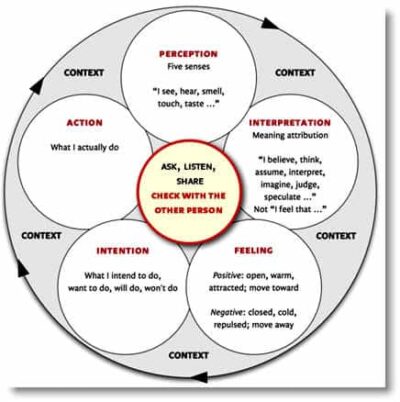
I think that the two “hardest parts” of any communication model are,
- realizing the difference between a feeling and an interpretation (thought), and
- doing what you say you will do. (action)

As to the first one, I was talking with a friend who said, “Yesterday was a really anxious day.” I replied, “Days aren’t anxious, so that would be better put, ‘I made myself anxious yesterday.’ ”
She said, “All my life, I’ve believed that there are good days and bad days—that externals cause feelings. You’re saying I caused my anxiety!”
I replied, “Not quite. You felt something in your body, and interpreted it as anxiety. Declaring yourself (or the day!) anxious is a thought. What were you actually feeling in your body?”
She said, “My muscles were really tight, and I wasn’t breathing much… holy crap, that fits! I almost never breathe very much!”
I then said, “Right. The feeling is tight and breathless. That feeling leads to the thought, “I am anxious.” In actuality, you could call the tight and breathless feeling in your body anything you chose. It’s just a label.”
So what’s the point here?
Well, often people use their feelings as bludgeons — they suggest, and none too subtly, that others are the cause—are to blame—for their poor little pitiful feelings.
I work really hard to get people to recognise and own their bodily sensations, while also owning the stories they tell themselves about those sensations.
This is what I mean by self-responsibility (among other things.) If I say, “Here is the story I’m inventing regarding the tight feeling in my stomach,” I have ceased to blame “you” for either the feeling or the thought.
This whole thing is very Zen.
Eastern Perspectives — clouds in the sky, mirrors in the mind
The first idea is this: we know things by their opposite, and all couplets are an essential unity.
The second idea is this: thoughts are not real — they are like clouds drifting along on a blue sky day. You could say that the clouds are there, but they have absolutely no effect on the sky. Or they are like reflections in a mirror—seemingly real, but only there until they are gone.
Opposites

I’ve likely mentioned this before, but it is impossible to know anything unless we have something to compare it to. So, for example,
We know that water is hot compared to water that is cooler.
We know that something is tall, compared to something that is shorter.
We know pleasure as it is compared to pain.
And, (here’s where it gets sticky) we know happiness because there is sadness to compare it to.
Which flies totally in the face of all the people out there who want to lead a “happy life,” and can’t comprehend why happiness doesn’t exist 24/7.
Here’s a twisty-turny part. You think that you are inside of you. That you live “in there.” You might even think that inside includes your outside — your skin.
But it is impossible for there to be an inside by itself. Or an outside.
Therefore, if something cannot exist without its opposite, the “opposites” are, in reality, one thing. So, you are not only your inside, but are also essentially everything outside of you, and the whole thing is one unity! Insides and outside are simply two aspects of the same thing. (Two sides of one coin.)
Many people are caught in the dreamland of thinking that everything should work out fine — and that all people should be healthy, happy, wealthy, and wise.
And yet, these terms are relative, in that they have to, by definition, relate to something else — sickness, unhappiness, poverty, and dumbness.
Everyone is somewhere on a continuum — somewhere relative to something or someone else. Thus, for example, perfect happiness cannot exist, because it begs the question, “Compared to what?”
This is just the way it is. Railing against it changes nothing.
Indeed, we can take any one of these couplets, and recognise in them the Yin/Yang symbol. Or, visualized another way, if happiness is one side of the coin, unhappiness is the other.
In the words of the song lyric, “You can’t have one without the other.” No matter how much you wish it were otherwise.
This fits into good communication in the following way.
Most people go through their lives one day out of sync. Rather than living in the here and now, their focus is on tomorrow. Always tomorrow.
The judgment is,
“Things really suck today, but tomorrow my Prince(ss) will come everything will be perfect!”
The same thing applies to how they deal with their partner. There’s the thought that,
“He really screwed up today, but if I keep nagging at him, maybe he’ll be better tomorrow.”
This, as opposed to,
“This is how it is right now, and here is what I will do to shift things in another direction.”
We really do need to stop judging our lives on the basis of how we imagine they ought to be and begin accepting them as they are.
Accepting doesn’t mean accepting forever.
It means accepting how things are right now as how things are right now.
In this way, we stop playing mental games with ourselves. We stop blaming the world. We stop pretending that we can force the world to behave itself according to our standards — that our indignation can eliminate the Yin/Yang-ness of life.
And the reason we want to learn to do this is it’s simply a waste of time to think otherwise.
Clouds and Mirrors
I know. That one was pretty obscure. Rather than trying to pin it further to the ground, what I’m really trying to say is this.

Thoughts are like clouds in the sky. We see them, and we think, “Wow! Those clouds are huge! They are so big they could knock down a house!”
Except, no they aren’t, and no they can’t. They may have some substance — they do exist — but they don’t amount to much.
Just like our thoughts.
Or, think of your mind as a mirror, and your thoughts as reflections.
Mirrors have nothing to do with what they reflect. An object comes into view and the (normal) mirror reflects an image back, while taking nothing of the thing reflected into itself.
The image is unreal, ephemeral.
And no, I’m not really talking about analytical thought. I’m sure Einstein developed the Theory of Relativity partially in his head. That might have been a useful thought.
I’m thinking about the kind of thoughts that lead precisely nowhere.
For example, many people in couples will say stuff like, “I know exactly what he’s thinking.” And I wonder aloud if she’s asked him, and she assures me that she doesn’t need to — she just knows. Well, phooey.
Whatever is going on in your head is just your story
What you believe about how you were parented, what you believe about your relationships, what you believe about your child-rearing skills, what you believe about your employment — it’s all just you, talking to yourself —and it’s all just as relevant as clouds in the sky.
In fact, if you’re trying to figure out what Zen is all about, it’s not really about the sitting. It’s about watching your thoughts while sitting, and noticing how fleeting and unsubstantial they are. They arise, they drift by, they go — so long as we don’t grab hold of them.
It’s the “grabbing hold of” that gets people in trouble.
They get an idea about a situation, or an illness, or a person, and they not only believe that idea is true, they demand that others believe it too.
They ascribe all kinds of meaning to what other people are doing, with no data other than the stories they’ve invented in their heads, and then they expect the other person to agree with their story.
Likewise, they have all kinds of reasons and justifications for staying stuck, and get quite incensed when someone suggests they drop the nonsense and do something different.
Mirrors do not grab hold of what they reflect.
Dialog becomes “holding up a mirror” — “Here is what I see and hear, and here is the story I am telling myself.” There is no attempt to change the other person—there is just mindful feedback.
In Zen, and communication, and in life, what matters is not the stories we tell ourselves inside our pointy little heads, but rather what we do when confronted with a dilemma.
Rather than judge it, rather than fervently wish for its opposite, rather than hoping endlessly for rescue, we do something different.
We speak responsibly, owning our stories, describing our feelings and taking full responsibility for all of it.
And then we simply concoct an alternative behaviour and enact it. If it works, we do more of it — if it doesn’t, we drop it and attempt something else.
What you think doesn’t matter, the external world is as it is, and the only thing you have a modicum of control over is what you do next.
Choose, and enact, well.