

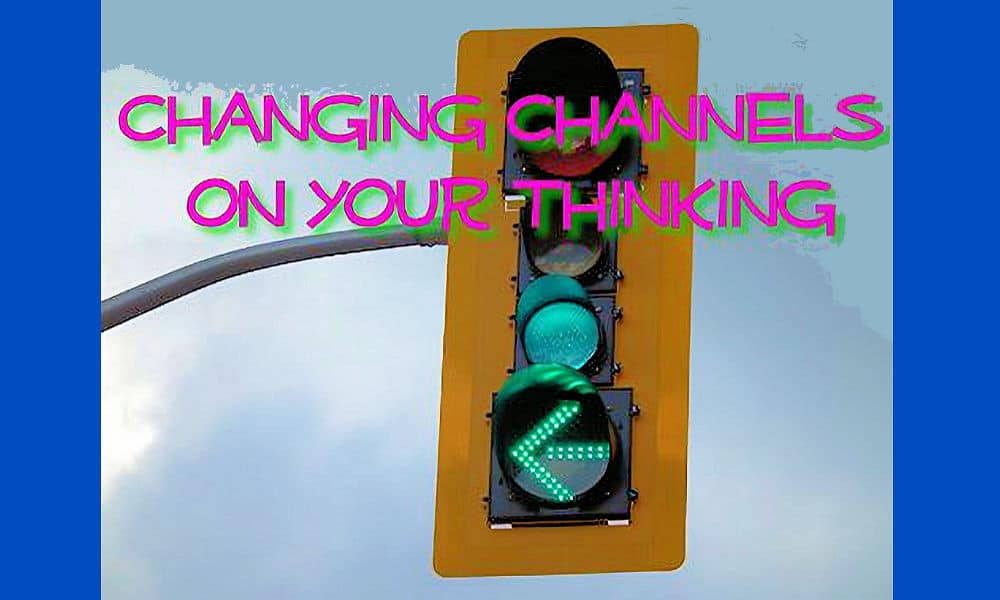
Changing Channels on Your Thinking — While certain aspects of our personality and behaviour are hard-wired in, what we choose to do with each situation is, fortunately, completely our choice.
Looking for more on this topic?
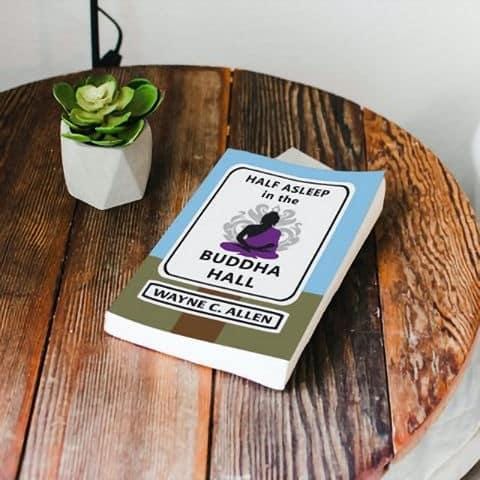
Check out my book,
Half Asleep in the Buddha Hall.
My “Eastern” book takes you by the hand and helps you to find peace of mind.
Half Asleep in the Buddha Hall is a Zen-based guide to living life fully and deeply.
(Here’s a direct Amazon link)
Purchase digital versions (Apple, Nook, Kobo, etc.) from this page

A while ago I was finishing up a Bodywork session with a client, following a discussion about her patterns of behaviour. She had noticed that, when something in her relationship went sideways, she found herself questioning, judging and blaming herself.
I said, “As we’re standing here, every radio and TV channel that reaches Waterloo is present in this room. That we can’t hear or see them is immaterial.”
She brightened, and replied, “We get to choose what channel we listen to!”
Obvious, right? Well, it is now that you are thinking about it.
Now, imagine there was a station (say FOX News…) that only broadcast hateful, judgemental, annoying, creepy messages. 24 / 7 sewer bilge.
You’d think that such a station would never get a listener to tune in.
But when it comes to the channels in our heads, which are also there and available 24 / 7, almost everyone has a “hate Channel,” as in:
- it tells you how terrible you are, or
- how everyone is out to get you, or
- “If you don’t get straight “A’s” easily, you are stupid and will never get a good job and will end up living under a bridge. (The “living under a bridge” part is MY favourite!)
Yeah. Right. It’s got the highest listener-ship on the chart.
Yet, as my client said, “We get to choose what channel we listen to!”
Refusing to understand and practice “channel shifting,” refusing to see what’s “really going on,” is the greatest impediment to living full and rich lives.
- Someone has a friend who constantly berates and judges her. She ends the relationship, then “runs into” the person, and off they go, to talk. 95% of the time, the old pattern re-emerges.
In the words of today’s article, “I start listening to the channel that tells me that everyone has to like me.”
- Another has difficulties setting relating boundaries with his partners. He sets one, his partner invites him to cross it, and he does. Feels used and miserable.
“I start listening to the channel that tells me to always say yes to pretty much everyone, and especially women.”
- Another upsets herself any time something doesn’t go “right.” In an instant, she’s boiling mad.
“I start listening to the channel that tells me that everyone is out to get me, and that I have to fight back.”
If you listen, you can quickly find the favourite channel for yourself, and for everyone you know.
The joke, of course, is that the “favourite channel” is one of many.
And, there are even several channels available that promote stuff that actually works. (Being present, doing things differently — the stuff I write about!)

This rule applies across the board — even if I have a “real, diagnosed” mental condition, like depression or anxiety.
If all I listen to is station, “O.H.M.Y. — the Poor Me station that rocks!” — I can guarantee staying stuck.
If I switch channels, and say, “Given who I am and how I am, here is another choice of action” — “Smooth Blues, station C.H.O.I.C.E.”, for example, then a door opens where there was a wall.
Changing the channel requires… changing the channel!
When things go wrong…especially then… I must consider:
“Will I try to fix this problem by repeating my pre-existing understandings, or will I let go of thinking that old patterns that never worked will magically work this time?”
I can still amaze myself over how willing people are to make excuses for clinging to what doesn’t work.
There is a huge difference between accepting who I am while also making better choices, and justifying staying stuck by defending and implementing what doesn’t work.
The appeal of “repeating what doesn’t work” is simple.

Change requires both effort and the conquering of fear of the unknown.
Remember, 100,000 generations ago we huddled with our families and tribes around fires, trembling in the dark, and life was short, and brutish, and filled with predators and enemies.
Our “fear — threat” patterning is ancient and hard-wired.
We appear to be much more sophisticated, until we are “threatened.”
“My boss doesn’t like me!” “I only got a ‘b’ — my life is over!” “(Wo)men don’t treat me right!” “What if I choose wrong?”
Suddenly, we’re huddling again, even though there is no threat. And we’re listening to the familiar voice of the DJ at
“C.R.I.P.E.S. — the station that wants you freaked out and scared — ’cause it’s good for the ratings!”
So, is there ever a real threat? Of course! For most of us, there are likely one or two real threats in a lifetime. (Unless you choose a profession like cop, firefighter, military person — then, there are daily threats. Due to choice of occupation, not created out of smoke and mirrors.)
Living our lives in fear and trembling isn’t a necessity — it’s a habit.
“It’s how I am,” is a cop out. Always. “I can’t help it,” is untrue. Always. “I’m the way I am because of what was done to me,” is foolish. Always.
What is true is that doing things differently takes great courage and great understanding, and most people simply don’t want to exert the effort to repeatedly change the channel.
Lazy and stuck is simple.
I found a pretty good quote the other day:
“There is a great difference between knowing and understanding: you can know a lot about something and not really understand it.”
–Charles F. Kettering
Understanding requires clarity of thought and shifting of being, as opposed to lip service.
The way I am is the way I am until I choose to make other choices. Getting all defended and annoyed is childish, and of course means you stay stuck.
This week, think about all you know about yourself, and go ahead and feel good about what’s working. Then, focus in on the things (behaviours, actions, interpretations) you know about yourself that regularly get you into trouble.
Wonder a bit what you are missing, and why you are choosing to keep enacting the things that get you into trouble.
Ask yourself,
“What would happen if I stopped justifying and defending what doesn’t work? What would happen if I dedicated myself to coming into a place of understanding, and from there, into making other, better choices?”