

Non-Habitual Living and Being — The way we view our lives, and ‘reality’ is not true. In fact, it’s simply an unconscious habit. Learn ways to recognize habitual thinking and behaving, and then, learn how to change it.
Looking for more on this topic?
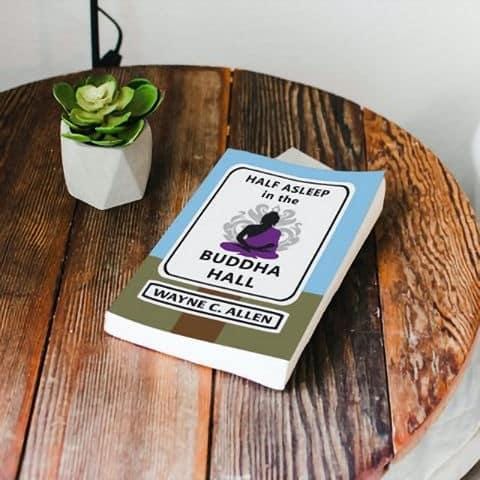
Check out my book,
Half Asleep in the Buddha Hall.
My “Eastern” book takes you by the hand and helps you to find peace of mind.
Half Asleep in the Buddha Hall is a Zen-based guide to living life fully and deeply.
(Here’s a direct Amazon link)
Purchase digital versions (Apple, Nook, Kobo, etc.) from this page
For most of us, this is going to seem a strange topic, as we assume that habits are somehow just there, as opposed to something we actively engage in / with (and cling to.)
When we consider the word habit, we think of things like excessive drinking, smoking, or other activities that seem to get us into trouble.
A better way to define a habit is:
The repetition of an often unconscious behavior which was created through repeated practice.
Here comes the weird piece.
The biggest and most profound habit that we have is how we view, understand, and live life.
Although we’ve talked about this before, we’ve really never looked at it from this perspective. Let me put it this way:
The way you view your world is not true; it’s simply your most deeply ingrained habit.
The process of primary habit creation is called socialization. Our parents, our relatives, and our tribes have a lot invested in getting us to mindlessly repeat their view of the world.
On a much more profound level, socialization provides us with the tools and resources we need—not only to fit in but to be able to live at all.
I really need to repeat this.
These stories aren’t true—they’re simply habitual expressions of how we believe the world works.
Here’s another odd piece about this habit we call life.

This primary socialization might also be thought of as a way to make us normal.
It’s as if there is some invisible standard that everyone is trying to live up to, and the odd piece is that this invisible standard is pretty boring.
- Normal just sits there.
- Normal doesn’t rock the boat.
- Normal doesn’t make waves.
- Normal fits in, or at least tries to.
And this normality is so ingrained, so habitual, that we don’t even notice we are playing this game.
OSHO wrote a book called “The Book of Secrets.” It describes OSHO’s take on Tantra.
According to OSHO, the main Tantric theory has to do with using the body, fully and completely, to wake up. There are 100 plus techniques that can be used to help us to see what’s really going on, as we free ourselves from our habitual view of life.
I want to provide you with a couple of reasonably long quotes, just to give your perspective on how OSHO saw normal.
And what is normal? What is normalcy? Just the average. If the average man himself is not normal, then being normal means nothing. It simply means you are adjusted to the crowd. So Western psychology is doing only one thing: whenever someone is maladjusted, Western methods make that man again adjusted to the crowd. The crowd is not questioned at all; whether the crowd itself is okay is not the question.
pg. 221
OSHO suggests that the Eastern approach comes at this from a completely different perspective.
In order to understand this, you have to “get” that, in the West, the mind is seen as an endpoint — that nothing exists beyond the mind.
It is assumed that mental illness actually exists; that it is an illness of this “thing” called the mind. The role of the “mind doctor” is to fix the broken part; this is understood as the only way to bring the person back to normal.
In the East, the mind is the illness.
For Tantra, man himself is the disease. It is not that your mind is disturbed—rather, your mind is the disturbance. It is not that you are tense within, but rather you are the tension …if the mind itself is the illness, than this illness cannot be treated. It can be transcended, but it cannot be treated.”
p. 261
In the East, there is something that lies beyond the mind. Through focus, through presence, through meditation, one can find a certain stillness. This stillness transcends the mind. In fact, mind is thought of as a hindrance.
The mind is described as “monkey mind”

It flits from one thing to another, picking something up and getting distracted, flitting to something new, getting distracted, and on and on. There is nothing valuable in this.
This is the nature of mind. It can’t be suppressed. But it can be examined, and what you find are … deeply ingrained habits.
Fritz Perls said,
“Go out of your mind and come to your senses.”
Transcendence has everything to do with moving beyond normalcy.
OSHO, again:
The Eastern effort is for how to transcend the mind, because for us there are no mental diseases, remember. For us there are no mental diseases—rather, the mind is the disease. For Western psychology, the mind is not the disease. The mind is you, it is not the disease. The mind can be healthy, and the mind can be ill.…
Unless you go beyond mind, you can never be healthy. You can be ill and adjusted or you can be ill and maladjusted, but you can never be healthy. So the normal man is not really healthy. He is just within the boundaries, he is ill within the boundaries. The abnormal person is one who has gone beyond the boundaries; and the difference between the two is only of degrees—of quantity not quality.
p. 121
Good little sheep, fitting in.
We might say that the goal in the West is to herd people back into the fold of being normal, predictable, non-sensual, selectively sexual, and without an opinion of his or her own.
That last part, about not having an opinion, may feel unreal. You may want to say, “Of course I have an opinion, and man am I ever going to give it to you!”
But really, there’s a lot of truth to the expression, “There’s nothing new under the sun.” What you believe is your opinion is nothing more than something you’ve heard and choose to parrot as if its “true.”.
I suspect you can remember a time when you expressed an opinion in a group of people who disagreed—and how, almost immediately, great anxiety arose in you.
You felt isolated, scared—and you either toughed it out and argued more, or did whatever you had to do to get back into the group’s good graces.
Difficult, very difficult, to smile, hold to your opinion, and not defend.
That anxious feeling is something you should pay attention to.

Anytime you feel a disturbance inside—queasiness, tightness, imbalance, or just a sense that “something is not quite right,” that’s you bumping up against your habitual thinking.
Your body says to you, “Something is going on here that you need to
pay attention to.”
Mostly, in such situations, this anxiety is such that we simply want to go away. And the best way to get it to go away is to ignore it by shifting into neutral—to become normal again.
In traditional “habit therapy,” there are two ideas that I think hold water.
The first is that a habit can’t just be stopped. It has to be replaced with a new behaviour. The second is that it takes around 25 days for this solid, new behavior to become a new habit.
This is pretty much how people stop smoking, or stop drinking, or stop swearing.
And… as anyone who has “overcome” an addictive habit can tell you, the old, much deeper habit it “right there,” waiting to leap to the forefront.
So, the new habit has to be implemented repeatedly.
It’s an entirely different kettle of fish to break the habit of how we live.
The first step in this process is to believe that something exists beyond mind, beyond habit, and beyond our current belief.
OSHO calls this transcendence.
Ken Wilber speaks often and passionately for a method that he calls “transcend and include.”
By this he means that we take what we have, stop judging it, accept it as an aspect of ourselves, [that’s the include part], and then move past it in a direction that is, larger, more beneficial, and, at the same time, more detached. And yet more individualized. [That’s the transcend part.]
One cheap and dirty illustration of this is learning to meditate.
I got my first taste of meditation at University, back when I was about 18. There was a Transcendental Meditation group that I became a part of.
Now let me tell you, I have a lot of energy in my body, and sitting still is nothing short of a miracle for me. I’m not sure how Darbella sits next to me when I drive. Talk about the endless wiggle.
Back then, when I was a kid, there was always something better to do than just sitting there.
Zazen means “sitting still like a mountain.” My mountain had tremors—earthquakes—and all I wanted to do was get up, move, do something.
The West is full of doing. Being? Not so much.
Over the last few decades, I’ve been putting much more focus into meditation. And oddly, he says with a grin, I’m sitting still.
Better put, I’m sitting in the stillness.
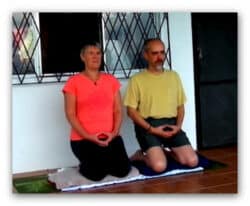
I’m not sure this is a habit yet, but it’s darn close. And there’s sort of a pyramiding effect; the stillness is extending into my non-sitting moments.
I find this to be a good thing.
Transcendence comes to us when we first allow for the possibility that something exists beyond what we presently believe to be so.
The funny part is, we’re getting body cues that this is so, all the time. Aches and pains, queasy feelings, that nagging sensation that there’s something seriously wrong with the way things are right now.

We’ve been conditioned to ignore these feelings. Hell, we’ve been conditioned to ignore our bodies entirely. Except for a few, socially sanctioned, acceptable bodily feelings.
I endlessly try to get people to pay attention to the signals they’re receiving all the time.
I see tight little bodies, aching minds, broken spirits. And then I hear, “It’s not as bad as it seems. I’ve just got to do more, toughen up, and win the lottery.”
I so desperately want to reach out and give people a shake. I want to yell, “Pay attention! Your body, your spirit, is trying to tell you something! Please, this time, listen.”
What I’m looking for is a harmony, a dance, between body, mind, and spirit.
Too often we get into focusing on one thing to the detriment of the others, and in our culture mind predominates. And Lordy, are our minds ever messed up.
We hurt. And then we go on doing the same things, trying harder, working harder, running faster, and falling down, exhausted.
Our bodies and spirits keep trying to get through to us, but it’s hard to listen. We’re so afraid will no longer fit in, that will be judged, that will be rejected, that will be blamed, that somehow we’ll die an outcast.
see: My Husband and My Pelvis
Transcendence comes to us when we realize the utter stupidity of this belief. We transcend when we understand that we are bigger than this, and are meant for full being.
We transcend when we refuse to suck ourselves down the drain that our society has created.
Transcendence begins with sitting.
With quieting. With bringing our focus back to where it belongs.
Transcendence begins, as I listen to myself, accept myself, forgive myself, bless myself.
From this place, I can simply be, and “who I be” becomes how I live and how I enact myself.
I break the habit of being normal.
I discover that standing forth as a whole, centered, focused, and clear human being is ultimately, what life is really all about.
The worst habit you can have is to live your life as if you have no choice. Continue to ignore yourself at your peril. See with new eyes, and the world and you are transformed, transcended, and whole.
It’s up to you. What are you waiting for?