
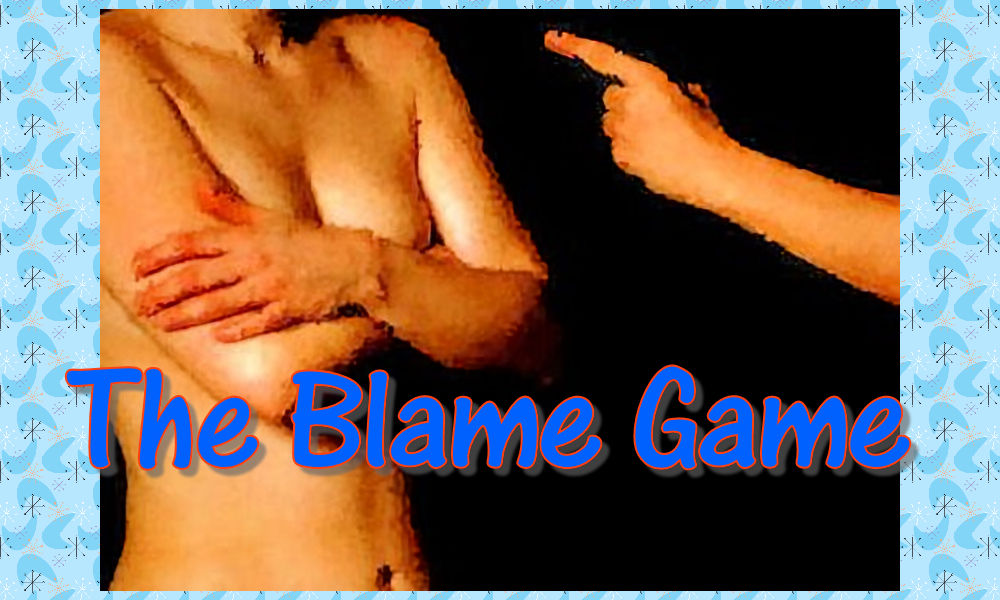
The Blame Game — blaming situations or others is a great way to live a small and meaningless life. Things change when we accept responsibility for our lives, and then do something different.

My first and most popular book,
This Endless Moment.
Learn to live a full and satisfying life.
My analogy of choice these days is this:
Once you get past the age of 16, ‘the cosmos’ hands you a rubber mallet, which is normally used to knock furniture together without marring the wood.
The cosmos then offers you this strange deal.
You can accept complete responsibility for your self - for your choices, for your thinking, for your actions
— or –
You can blame
the situation or others.
If you pick the former, you get to drop the mallet.
If you choose the latter, you begin, with rhythm and verve, to smack yourself in the forehead with the mallet. On and on. For the rest of your life.
In the past, I’d describe this to clients, I invite them to drop the mallet and stop hurting themselves.
This would elicit a smile, a rueful nod of the head, and then out would come a story or explanation that demonstrated they were still swinging the mallet.
Blaming

We blame because it’s easier.
A feeling of discomfort arises in us (usually in the chest or belly.) Rather than explore our self-created feeling, we look for an external.
Since we are surrounded with “stuff and others,” there’s always something.
And the mallet swinging commences
We either pick a fight, or run away. (Classic fight or flight.) In either case, all we are doing is causing ourselves pain by keeping ourselves caught in the imaginary drama we ourselves created!
Here’s a rule for you: all internal discomfort is self-created.
From Shambhala Sun’s Heart Advice comes this quote from Pema Chodron’s When Things Fall Apart: Heart Advice for Difficult Times
There’s a slogan in the mahayana teachings that says, “Drive all blames into oneself.” The essence of this slogan is, “When it hurts so bad, it’s because I am hanging on so tight.” It’s not saying that we should beat ourselves up. It’s not advocating martyrdom. What it implies is that pain comes from holding so tightly to having it our own way and that one of the main exits we take when we find ourselves uncomfortable, when we find ourselves in an unwanted situation or an unwanted place, is to blame.
This slogan is a helpful and interesting suggestion that we could begin to shift that deep-seated, ancient, habitual tendency to hang on to having everything on our own terms. The way to start would be, first, when we feel the tendency to blame, to try to get in touch with what it feels like to be holding on to ourselves so tightly.
A client said she wanted to “make a contribution,” but whenever she got a new opportunity to stretch her wings, she ran home and hid under her bed. Rather than confront her desire to “mallet beat” herself, she repeated a litany of stories designed to keep her stuck under the bed.
Another client told me that his wife left him because of:
- the Women’s Movement,
- her having too many choices,
- her hating where they lived, and
- her “lack of family values.”
I suggested that we talk about his part in the breakup, and said that perhaps he sucked at relationships.
He didn’t disagree, but immediately went back to his list. I then pointed out that his list contained no items he could do anything about, so he was really setting up a system to be alone.
He spent the rest of the session sighing and telling me, colourfully, that I’d missed the point.
And then there’s me…
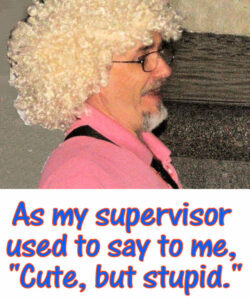
A while ago I got a call, and the caller asked me to do something I’d rather not do.
Not something awful, more of a stomp your foot, “I don’t want to!’ kind of thing.
I told Darbella about the request, and asked her what I should do. Dar just smiled and handed the ball back to me.
Now, Dar has done this for 44 years… handed my responsibilities back to me. And often, l begin to anger myself.
Pretty soon, I was getting “intense,” and Darbella was getting quiet. And at that point, I had a choice.
OK, everything I did was my choice, and I initially picked trying to pass the buck. (The Loonie, actually, but it doesn’t sound as good…)
The choice? To blame Dar, or to have a breath, express my frustration (without blaming the caller either), and decide what to do.
All of this was me setting me off, because I didn’t choose to say “no” directly. And, another part of me wanted to do it, because the people involved were friends.
Poor me, eh?
So, up comes the mallet. My initial reaction is: I’d rather be stuck, in pain, whacking myself. And I’ll also try to get Dar to pick up her mallet and play along.
Fortunately, after decades of observing my games, I can see myself… and my games… and choose to stop myself. So I had a breath, and stopped. Darbella and I then had a conversation about the request.
In that instant, I felt the weight lift off my chest.
In each of these examples, the hammer swinging is being done by the hammer holder.
There is only one time when this is not the case, and that’s in terms of physical violence. If someone else is literally wielding “a hammer,” then the other person causes the wound.
In every other situation, in every other relationship, in every other case, the hammer is being swung by the same person that is being hit.
Thus, “Virtually All Wounds are Self-Inflicted.”
A lot of this goes back to childhood, when we had an expectation that our happiness and well-being was in the hands of others — we were “right” to the extent that we were kept alive by others. The jury is out as to the happiness and well-being part.
Despite the fact we’re no longer children, we often want to be looked after, amused, made happy, and given a guarantee that “Everything is going to work out just the way I want it to!”
People tell me that’s why they are in relationship. It’s funny, though, how once the novelty wears off, “He makes me so happy,” becomes, “He makes me so angry. He’s changed!”
A friend was bemoaning her fate the other day, describing her husband thusly: “He hates his job, is good with the kids, but fights with my son, and never wants to do anything. He’s really quite boring.”
The interesting piece, to me, was that I’d asked her how she was doing.
I asked her again, and she reluctantly described her own quite boring life.
This is not to say that her husband might not be boring. It’s to say that her boredom is not caused by or about him. She’s boring herself, and blaming him for not making it “more fun.”
Which, when you think about it, is the perfect game. When she’s happy, she can say “I had a great time!” When life sucks, its, “You’re so boring!”
Often, the power struggles that appear to be about who is right are actually about who is responsible.
Each person blames the other for the problem. “If only you’d get it!” (Like my first client story: he wants me to “get” how powerless he is, and also how powerless “everyone” is. But it begs the question: why would I want to be powerless in regard to my own life?)
As we play the blame game, we let ourselves completely off the hook for the pain we are feeling.
Blame. Excuses. “I can’t!” “I’m scared!”
We need to learn to have a breath, to grow up, and to take responsibility. The life you have, right now, is solely what you created. Solely.
You don’t like it? Change something! No whining about how hard it is, no, “But what if it doesn’t work out?” Nothing changes until you do.
It’s time to notice and admit to the games you’re playing. Time to let go of the tightness and lack of fluidity that comes from blaming.
No one is doing stuff to you. No one is making you miserable. No one is trying to hurt you. All that stuff you’re stuffing, all those emotions, are yours. They’re yours to deal with, let go of and move past.
No one owes you different behaviour. You owe you the ability to claim and own your behaviour.
In short, you could choose to put down the mallet.
Otherwise, you’re the helpless victim of your self-inflicted wounds. Sounds like a screwy way to live your life, if you ask me.