
Romance is sanitized, socially acceptable lust. It’s also a minor stage in building a deep and meaningful relationship. Romance inevitably leads to conflict, and can lead to a depth that is quite remarkable.
Just a note. I shifted this blog over to Substack, so you’ll be getting a different looking email with each week’s post.
The substack is at https://substack.com/@wcallenont
The archives are there, too (as well as on https://phoenixcentrepress.com for the time being.

Simple, profound lessons in relating
The. Best. Relationship. Ever.
Purchase all formats at Amazon
Purchase digital versions (Apple, Nook, Kobo, etc.) from this page
The Essence of Romance

Lucy in the Sky — Romance is a Stage
I want to say a bit about romance today, and how it is a stage one progresses through, rather than something “in and of itself.”
Before I get there, let me mention a few things, and remind you of some resources.
If you’ve been reading my stuff for a while, and many of you have been around here since the days of Into the Centre, some of this will be familiar.
To begin with, there are four free booklets available on our website. Three of the four are about establishing and deepening your understanding of elegant relating.
One of the booklets, The List of 50, recently became a book called Find Your Perfect Partner. The booklet is still available — I’ve rewritten it into a summary of the book.
If I were to put the three booklets into logical order, it would be
The List of 50,
Building Deep and Lasting Relationships, and
The Responsible, Compassionate Relationship.
The List of 50 came about when I was 32 — way back in 1983. Up to that point, I’d made a career of strange relationships. Certainly from university on, I quite rigidly followed the path that leads from lust to romance. Which is not to say I couldn’t tell the difference.
At 32, I became painfully aware of my past tendency to want to domesticate lust-driven relationships.
Let me give you one really blatant illustration.
I went off to university at 17, and would say that I was book smart and life dumb. By that point, I really hadn’t failed of much of anything I put my mind to, and on those rare occasions when I screwed up, mom and dad were right there to fix things.
Despite having a full ride scholarship to any university in New York State, I decided to go to Elmhurst University, 20 miles outside of Chicago. This was the first time I was away from home for an extended period of time, and it didn’t take me long to get into piles of trouble, some of which I ought to tell you about someday.
Example: I’d saved up a few hundred dollars (remember, this was 1968, and that seemed like a lot of money) so my first awakening happened when I had to actually buy textbooks. I was quickly broke, and took a job at Walgreens — a drugstore chain.
It was there that I met Irene.

I threw out the photo she gave me, but my mad web skills have found it online — her graduation photo. IMHO she was drop-dead gorgeous. I took her to my spring Fraternity dance, and the music stopped when we walked in the room. I was deeply, head over heels, in lust.
I had no problem basking in the reflected glory of the woman on my arm.
So, here’s the reason I’m telling you this story.
I was at Elmhurst University to get a degree in religion and psychology — I intended to be a Minister (which did happen, albeit somewhat delayed) — and one of the things I had decided was that sex was going to wait until marriage. (I changed my mind a month or so later, but that’s not part of the Irene story.)
A few days after the dance, Irene invited herself up to my dorm room. At one point, I excused myself to go to the john, and when I came back, Irene was undressed and lying on my bed. This was a first for me. Nothing much happened, but that’s not the point.
What did happen was that I stuck to my “convictions,” and took Irene home, despite what I really wanted to do.
A day or so later I went home to Buffalo for Spring Break. I spent a lot of time thinking about what had happened, and about what I wanted to happen, and I kept bumping against the “rules” I had set up for myself. Being relatively self-aware back then, I was quite capable of recognizing my “being in lust,” but I couldn’t quite figure out what to do with it.
I can actually remember a very strange penny dropping.
I wanted this woman, badly, and had no paradigm that would allow me to have sex with her. So, as he finally comes to the point,
I decided that my logical choice was to marry her.
I tried to sanitize the lust into romance, in order to get what I really wanted.
Irene was Roman Catholic, and that wouldn’t do for a Protestant minister, so I went back to Illinois with three or four books under my arm, intent on converting her. (I’m actually sitting here laughing as I write this. Yikes! What an arrogant little guy was back then.)
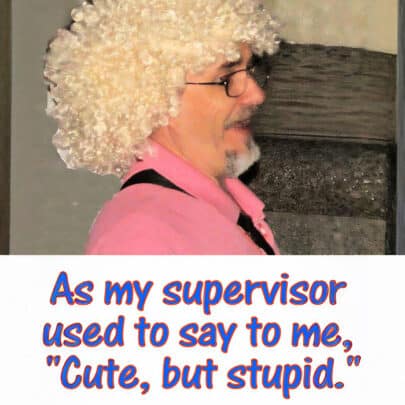
I handed her the books. She looked at them, and got really quiet. She then said, “But, I’m just here for the sex!” Shocked, I ended the relationship on the spot. (See lead photo of me, in the wig.)
Nuts, eh? Yet, I think it’s still pretty common.
Many of my clients are in relationship with someone for exactly this reason. I hear a lot of, “When we first met, I was really turned on by him, but now I’m not so sure.”
The piece they don’t get is that this is a part of the natural progression of relationships.
The level of sexual “charge” goes down over time because the object of our desire, emphasis on object, becomes a real person. As this de-objectification process escalates, a real sense of futility can set in.
Anyway, romance is a stage that emerges out of the miasma of lust, emotions and hormones.
Romance is lust, sanitized.
As such, it’s simply a stage that the wise “transcend and include.” In excellent relationships, both romance and lust are players in a much bigger play. Unfortunately, most people get bogged down here, and never move past romance to something more useful.
I got a neat Facebook posting today, from an old friend — she gave me an update on the last 10 years of her life.
She wrote,
“I have been part of serial romances in the past 5 years. I do see the value of them as healing tools though, re-opening those old wounds for deeper healing to take place. I kind of think of it along homeopathic lines ‘“ ‘like curing like.’ I don’t know if you agree with this philosophy.”
I have no idea about any of the dynamics of her serial romances. I just thought her comments were highly appropriate, given this article.

Romance, as we’ve noted, is a stage. In the early going of this stage, the norm is to be star-struck and half blind. You look at the person you are in romance with, and you only see what you want to see — a confirmation that this person is your perfect match.
I got another e‑mail from a semi famous relationship coach. He was announcing his impending marriage — after knowing his intended for less than six months.
He passed the relationship by some of the coaches he trains, and got the expected range of response. Some were horrified, others danced jubilantly around the altar of, “Ain’t love grand!” Anytime anyone raised a question about the relationship, the coach defaulted to, “She is my soulmate.”
Which is another way of saying he’s deeply enmeshed in romance.
None of this is to say the relationship will not work out — time, and only time, will tell.
The important thing in any relationship is not the places where we agree. The growing edge is always in how we deal with the confrontation that comes from differing opinions.
Let me show you how this goes. In North America, approximately 50% of all marriages end in divorce. An even more interesting statistic is that 75% of second marriages also end in divorce. 25% of third marriages end in divorce, so obviously we get more clever with practice.
The reason, I think, for the 75% figure is that most people come out of relationships blaming their partners for the failure. They therefore go into the next relationship and do the same dumb stuff, and then are amazed when that relationship tanks too.
Romance leads to conflict, or, said differently, conflict is a stage that follows romance — 100% of the time.
What we do when conflict hits varies. One choice, the statistically most prevalent choice, is to leave. This is what my friend calls serial romance. Others call it serial monogamy. You get to a wall marked “Conflict,” and you’re given the choice of door number one, door number two, or door number three.
Door # 1–The wide first door is marked “EXIT.” It doesn’t matter what excuse you give for exiting. “I’ve learned all I can from this relationship,” is no different from “I can’t stand the pain of this conflict, so I’m leaving,” as far as the actual result goes.
Door # 2–Of the 50% who stick it out, 40 to 45% choose apathy as their way of dealing with the conflict. The picture I get of this is typical of what most marriages looked like prior to the 50s or 60s — when divorce became socially acceptable.
This picture is like “Father Knows Best,” where the mother waltzes around in a housedress, and dad comes home, and retreats to his home office or den, there to dispense wisdom, and to sighed deeply, over the foibles of his family.
You might say that the 70s version of this is Archie and Edith, sitting 3 feet apart, watching TV, and often being miles apart in understanding, compassion, and self-awareness. In other words, there is no open warfare — there’s a polite silence you could cut with a knife.
Which is not to imply that within that 40% to 45%, there is no fighting. Most of the couples I see are still caught in the loop of thinking that their partner should be what they want them to be. They come in to therapy to get me to change their partner back into the person they were in lust, then in romance with.
All relational fighting is specifically about this: getting the other (person or situation) to change so that “I” don’t have to.
Door # 3–Acceptance and Curiosity–The remaining 5%, the people who choose elegant and full-bodied relating, recognize that the point of relating is self-exploration. That’s why I love my friend’s expression,
“… re-opening those old wounds for deeper healing to take place.”
Yet, to accomplish this, you have to be willing to stick around — to work through the pain points in your own personality — as opposed to prematurely leaving. “I can’t do this any more” is often code for, “I am unwilling to confront this about myself.”
The conflict that is a part of romance is this: the more we trust our partner, the more of ourselves we are willing to reveal — and what’s left to reveal is the stuff we tried to hide.
In the initial stage of romance, we only or mostly show what we perceive as the “good stuff.”
If we are naive, we see our partner only through the eyes of romance, and think the way that they are presenting themselves is the way they actually are. This is naive because people in romance are predisposed to show the stuff that will keep the other person around.
As time goes by, little bits of the other stuff begin to trickle and slip out. Initially, this is chalked up to the other person having a bad day, or being off their feed, as the observing partner desperately looks for a way to excuse the behaviour — as opposed to integrating the behaviour into their view of the other.
Eventually, the partners grow so comfortable with each other that the other shoe drops. The “other stuff” becomes a flood of behaviour that is the other side of the person’s personality—the other side of the other person’s “good stuff.”
Typically, at this stage, clients tell me, “My partner lied to me!”
What’s actually happening is that the partner is finally telling the truth. Each of us is who we are, not who we pretend to be. If one chooses door three, acceptance and curiosity, this new material can be incorporated into how we see our partner, and we can begin to notice how we make ourselves uncomfortable.
For me, I spent decades trying to get my partners to become who I wanted them to be. In 1983, with the advent of the List of 50, I decided that from that point on I would only hang around with people who were not in need of fixing, but were rather people who were intensely interested in being self-responsible.
A month after writing my List, I
surrendered my need to fix — to be right.
Old soul, slow learner, that’s me.
Next article, we’ll talk a bit more about how conflict can lead to self responsibility and self understanding in a relationship built upon acceptance and curiosity.