


The Zen of Conflict — the essential disappointment comes from the pain of realizing that it is impossible have the same perspective as another.
Looking for more on this topic?
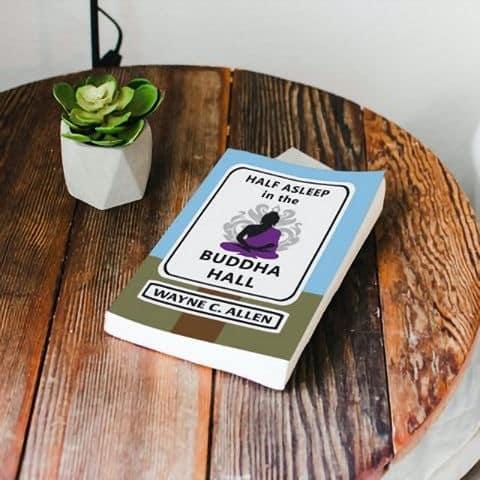
Check out my book,
Half Asleep in the Buddha Hall.
My “Eastern” book takes you by the hand and helps you to find peace of mind.
Half Asleep in the Buddha Hall is a Zen-based guide to living life fully and deeply.
(Here’s a direct Amazon link)
Purchase digital versions (Apple, Nook, Kobo, etc.) from this page
The Angst — the essential disappointment, comes from the pain of realizing that it is impossible have the same perspective as another.
Just a note. I shifted this blog over to Substack, so you’ll be getting a different looking email with each week’s post.
The substack is at https://substack.com/@wcallenont
The archives are there, too (as well as on https://phoenixcentrepress.com for the time being.
Dropping Drama’s Appeal — The Zen of Conflict

We left off last week having looked at “what happens next,” once romance fades. I said that this happens 100% of the time.
I guess you could say that the “romantic notion” is what gets blown out of the water. And that notion is that, if someone loves me, they will see things my way, and agree with me, and do things my way.
Because, after all, “I have finally found ‘prince(ss) charming’!”
While this is not a very radical idea, the cause of relational drama is that, despite finding a partner, you’re still going to die.
It’s pretty clear that anxiety starts when we recognize the inevitability of our own death. Most people are reluctant to discuss their death, and even flinch a bit over the death of people close to them.
In philosophy, the existentialists describe this anxiety as Angst —
the fear of non-being.
Romance is the notion that a relationship with “an-other” will somehow immunize me from death. If I am with the ‘right’ person, I will live happily ever after. My fears will dissolve, my needs will be met, and I will be forever blissful. And because of the hormone rush of lust, for a time, our chemistry is shifted to a state of bliss.
Betrayal feelings arise as the bliss wears off.

Romance allows us to step out of the day-to-day reality of our mortality. Conflict, then, might be seen as the end of the diversion through la-la land.
It’s what happens to Dorothy in The Wizard of Oz. Off she goes to Munchkins-land, where everything is mythopoeic — where heroes search for hearts and brains and courage, and good triumphs over evil. And then, she wakes up in Kansas, and (despite the ruby slippers) it was (maybe) all a dream.
If you substitute a wedding ring for ruby slippers, conflict is leaving Oz and returning to Kansas.
There is an addictive quality to romance (which actually does release opiate-like drugs into our brains) — the “flush” of romance is like a drug high. Easy to see why people crave it.
Conflict simply brings us back into the here and now.
In Zen, we work toward simple presence with whatever “is.” As such, a sense of conflict in view (and we agree here that all conflict is, at its base, a disagreement as to perspective?) presents us with the opportunity to either fight, or get curious.
The Angst — the essential disappointment, comes from the pain of realizing that it is impossible have the same perspective as another. You really, really have to get this one. It’s not that you haven’t found, or are not in relationship with, the right person. It’s that we, by definition see everything differently.
A simple experiment — stand next to someone and look at something.
Your tendency will be to think, “We are looking at the same thing.” Theoretically, the object you are looking at exists in some pure, undefined state. However, it’s impossible to prove this because as soon as we begin defining (thinking about) the object, we convince ourselves that the way we see it, is the way it actually is.
And the person next to you is doing the same thing. I can absolutely guarantee their definition is not the same as yours.
This is because of an elementary principle—perspective is everything.

Everyone brings their history to bear on everything “seen.” And none of us have the same history.
Another experiment. Go to an art gallery. Sit near a piece of modern art — say Picasso, or Dali. Listen, as people experience the piece of art. Some will love it, some will hate it. Some will “get it,” some won’t.
And remember, those you judge to have “gotten it” will simply be describing it in a way that is close to your way.
It’s like the elections in Canada and the U.S. The candidates have opinions on topics (the economy, industry, bailouts, etc.) If you take a step back, all you can say is, “Their opinions are different.”
But as we listen, our filters and experience kick in.
I’m a left-winger, and so favour, in Canada the Liberals (actually I favour the NDP, but vote strategically.) In the States, I would be a Democrat. So, I tend to “buy” what the candidates say, as they match up with my pre-conceived notions, and demonize the opposition.
Conflict happens when I bump up against my
pre-conceived notions of “how things are.”
As romance fades, I am left with the realization that my partner is not me, and comes from a totally different perspective. (S)he thinks differently, evaluates differently, and has an entirely different set of values. This is just the way it is.
Then, the Angst returns. “This time I thought I found the person that would rescue me from my aloneness and alienation. For a time, it seemed that this was the case. Now, I realize (s)he is not going to save me, and is also ‘wrong.’ ” (i.e. thinks differently than me.) “I’ve failed, been betrayed, again.”
Well, nope.
Conflict is the realization of a difference of perspective.
You can spend your time trying to force your partner into “seeing things my way,” or you can get curious.
Dar and I have been together since 1983, and as I look back, there has only been one time when we decided that we needed to agree. We had a talk about the foundation of our relationship.
We decided to discuss our “line in the sand …” the ‘make or break’ issue for us. Many couples we know have tons of such lines, and they tend to be picky and stupid. One client ended her marriage because she got home and her husband forgot to wipe out the kitchen sink. She assured me that this was proof of his totally disregard for her and her needs.
Dar and I decided upon “Complete honesty” as our “make or break” line. Simple. Efficient. Easy to put into practice as it fits with everything we say and do.
Beyond this one ‘line,’ none of our other conflicts have ever required that we totally agree. We have bumped our noses against the normal range of issues, and have discovered that we can work with each other’s perspectives. We are not clones of each other, and fortunately, we have been able to continually get over ourselves when we want to demand that the other person “comply.”
We do this by being curious, as opposed to looking for “who’s right.”
More on curiously next article.