
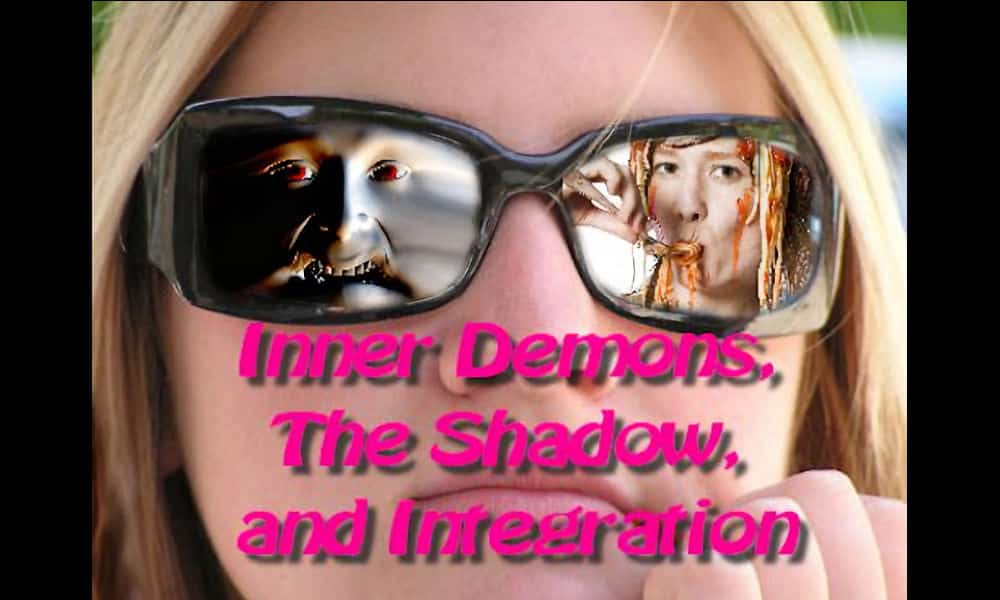
Inner Demons, The Shadow, and Integration — there’s the stuff we know about ourselves, the stuff we resist, and the stuff we stuff, — our Shadow. Working with all of it, non-judgementally, is key for becoming whole.

Living Life in Growing Orbits is our workbook.
52 weeks of daily exercises designed to help you figure yourself out.
Check out Living Life in Growing Orbits on our site.
Direct link to Amazon
Purchase digital versions (Apple, Nook, Kobo, etc.) from this page
I received a note:
This is what I want to learn how to do this summer:
To believe in myself… no matter what.
To find that calm, centered place in myself that will always be there, no matter what I do, how I perform, behave, etc. I’ve found it sometimes, but don’t know how to hold on to it when things get tough. Only have it when things are easy, and I need more resilience than that.
I need to find it, and stay there… I need to know I’m still here.
It’s time.
Here’s another:
I am trying to figure out who I am, and what I am, and what I want, and I keep reverting back to the same person that I was, and act the same way and then I get upset. It is ridiculous really. If it doesn’t work then why do I keep doing it? I keep asking myself.
Our Inner Experience
When we’re feeling down on ourselves, we fail to notice that the thing
we are “on about” has a message we need to hear.

I write a lot about internal states, usually in reference to energy moving in the body.
The feeling is common to all of us. Some choose to feel it, some choose to magnify it, some choose to use it, and some block themselves from it.
The other side of this coin is what I call our internal theatre.
This is the dialogue we have with ourselves, and is closely connected to the feelings and emotions we generate as we “play around” inside.
What we do is this: we promote the aspects of our interior theatre that we judge to be “good,” and repress what we judge to be “bad.” We also repress the material that we were taught to repress — and that stuff is so deeply hidden that we may only notice symptoms of it… the shadow, not the substance.
Carl Jung used the term “Shadow” to define the material that has been repressed

We all possess a full range of pretty much everything: skills, talents, emotions, thoughts, desires. It’s all in there.
To use an analogy, the stuff we play with regularly is foreground, the stuff we try to avoid is background, and the stuff we refuse to explore or even acknowledge is Shadow.
Here’s a hint: it’s not the stuffed material that’s dangerous — it’s the difficulty we make for ourselves in accessing it and deciding how to use it.
The second note I quoted, above, describes a common pendulum motion - she explores some background material, and then loses her grip on the “new approach,” and finds herself back in the “known behaviour” — even thought she desperately wants to shift her behaviour!
- Jung differed from Freud in his belief that the unconscious, shadow material is accessible – through therapy, through dreams, etc.
- For Freud, the material was locked away from consciousness, yet affected our day-to-day living through how we resisted dealing with it.
Jung also looked at the presence of the anima (yin energy) and animus (yang energy.)

He thought that animus was the male energy a female might repress, and then project outward on men.
She then ends up looking for her own masculine energy in men. And vice versa.
This fits with yin / yang theory, which posits both energies in both sexes, and suggests that the two need to be in balance.
The hidden energy, left un-integrated, “acts up” — if we try to balance ourselves by hooking up with someone outside ourselves, the balance is further eroded.
I’ve written about this in my book, Find Your Perfect Partner.
Through steady work and reflection, you identify the characteristics of the person you are looking for (making it easier to find him / her.)
More importantly, you discover that the person you are describing is the person you want to be. You discover “what’s missing in you,” and can then nourish, implement, and enact your missing anima / animus.
The “fix”, you see, is always internal integration.
Demons in the House
From any perspective, and certainly from a yin / yang one, every state of being is balanced by its opposite. When we are in a state of joy, sadness or despair has simply gone background. When we are excited, boredom is just around the corner.
Most Westerners believe that the job of living is to root out the “bad” feelings and experiences, and focus on the “positive” ones. They then beat up on themselves for not being able to pull this one off.
And of course they can’t. There is no such thing as a one-sided coin. This is what the person from the first quote, above, is setting as a goal — being present and staying centered, no matter what (feeling, state, experience) she is dealing with.
The Demons are the elements of our selves that we hotly deny possessing.
We are all of what we feel, think, plan, and do.
Notice the word,“ALL.” When I get angry, for example, or sad, (more likely for me) that’s me, feeling cold, tight, and shut down. That’s me, stomping off, hitting a mattress, or curling up in a ball. That’s me, thinking that the world is coming to an end, that no one loves me, that I NEVER accomplish anything worthwhile.
It’s me, giving in to my demons (as opposed to dancing with them…)
Now, I was well-trained. My mom was an expert finger pointer, and I learned at her feet. (No, I’m not mother bashing. We learn from our parents, who learned from their parents… that’s just “the facts.”)
So, my initial reaction is to want to cast blame. “If only they understood me…” “If only things were different…” “If only they’d stick around so I could fix them…” Externals to blame, ever present externals, and therefore I’m off the hook for my own mess.
The attendant feelings of overwhelm are strong. But I can always choose to dance!
What I’ve learned, perhaps all I’ve learned, is to sit down with my demons (who appear quite child-like and inoffensive when I refuse to bite on their drama…) stay put, and bring my attention to being present. And I see that I am whole, and what’s going on “in there” is me, is mine.
I stop blaming, and start being self-compassionate. By being open (and empty) hearted.
Which is exactly what I’d do for someone else who was sad, or mad, or “in the stew.” I’d plant my butt, make eye contact, and hand out Kleenex. Not fix, not avoid, not blame, but listen and stay present.
The demons we face are as much “us” as the stuff about ourselves that we value.
So, it seems to me, the “cure,” such as it is, is to value the dark side as much as the light. (Yin / Yang originally meant “dark side / light side of the mountain”)
To accept that there are two sides to everything, including our thoughts, feelings, desires, and actions. Learning this is the beginning of wisdom.
When I stop fighting against myself, I can be with myself, and from there, more past the “heart of darkness,” without judgement, to the heart of emptiness and freedom.
Our quotes, above, speak of this.
Repeating non-functional behaviour is normal, and non-productive.
We do it because changing behaviours requires tackling our demons. Sitting with them, accepting them, and then choosing another way of being.
Becoming “comfortable” in (familiar with, non-resistant to) our dark pool is essential.
Not to stay there, but to be able to visit without trying to escape. I say to clients: “Any fool can get this stuff when nothing is wrong.” The key exploration happens when things, or we, go off the rails.
We fear our darker natures because the dark side is linked to non being — to our sense of death, and the futility and uncontrollable-ness of life.
And yet, stomping our feet and screaming, “It’s not fair! I don’t like this part of life!” changes nothing. And we end up with sore feet.
Going one step deeper, the Shadow material is simply “stuffed stuff.”
We know it’s there, because it pushes against our edges, and wants us to find it. It pops up in dreams, in slips of the tongue (Freudian slips) and in how we react when “pressed.”
What we’re looking to be is honest with ourselves.
If we are willing to explore the dark corners, we’ll discover incredible strength. We’ll find the areas of our selves that we have long denied.
Nothing says I have to enact these fragments — my angry, sarcastic side gets no air time directed at others. I do, however, “let it out” when expressing anger through pounding my mattress. That anger, physicalized, can keep me safe in “dark alleys.”
It’s not bad or wrong; it’s just a part of me with selective usefulness.
Other aspects of the Shadow seem useless
Many people (me too) have had bouts of sadness, melancholy, depression. These aspects seem unnecessary in the extreme. And yet… much can be learned by accepting that sadness is as much a part of each one of us as is happiness. It’s a felt sense, has no meaning, and must be borne, walked with, and let go of.
The “problem” is not the pain of sadness. It’s our tendency to grab on, cling madly, and whine about it.
Pain passes, if we deal with it authentically and deeply. It’s when we just “lie there,” covers over our head, that such things go on and on.
One client recently told me she was so depressed she, “couldn’t, wouldn’t get out of bed.” She then said, “… and then I had to get up and go to work, so I did.” Her story: couldn’t do it for herself, could do it for work. So, I ask you, could she get out of bed?????
Hmm.

This week, see what aspects of your self you are pushing away, denying, resisting, and see if you can walk a few steps with it, to see what it has to say. Mostly, notice the fearful voices are trying to look after you, but are doing so inappropriately.
We can make friends with all aspects of ourselves, and then, from this place of neither clinging nor pushing away, make a clear, next choice from a place of owning — from a place of integration.
Let me know how this goes for you!