


- Ideas for Zen Living: 12 Presence Presents
- 5 Communication Tips
- 10 Quick Examples of Zen Living
- Better relating — 6 Ideas
- Fearless Living — 7 Tips
- 5 ways to pay attention
- 10 Zen Principles to Help You Live Life Better
- 7 Ways to Live in This Endless Moment
- 5 Key Concepts for Zen Living
- 9 Tools for Relating
- 3 Riffs on Relating
- Vulnerability — 5 things
- 5 Life Lessons You Need to Get
- 9 Ways to Screw up a Relationship
- 10 Things Your Mommy Forgot to Tell You
- 5 Ways to Get Your Act Together
- Cure What Ails You — a Handy Dandy 5‑step Plan
10 Things Your Mommy Forgot to Tell You — We are taught from birth to only notice certain things. This is the process of socialization.
Psst!! Hey!!!
** Want more great writing designed to help YOU to shift your behaviour?
** Want to learn how to find, build or deepen your principal relationship?
** Want to know more about Zen living and being?
Check out Wayne’s books! (amazon link)
Or, check them out right on our site.
I’m calling this week’s article, “10 Things Your Mommy Forgot to Tell You,” — and I’m doing this in a sort of tongue-in-cheek way. But only sort of.
One of the key ingredients to actually waking up is becoming aware of what’s really going on. Mostly, as the quote mis-attributed to R. D. Laing reminds us,
“The range of what we think and do is limited by what we fail to notice. And because we fail to notice that we fail to notice there is little we can do to change. Until we notice how failing to notice shapes our thoughts and deeds.”
I want to unpack this briefly before getting to the list.
Failing to notice is conditioned behavior.
What I mean by this, is that we are taught from birth to only notice certain things. This is the process of socialization. It is, in its essence, the same for all of us, no matter where we live.
I think of this as our cultural or tribal upbringing. But it of course begins with our parents.
Everyone knows that their deeply held, core beliefs are as old as the hills.
These beliefs, coupled with societal repression, cause us to want to pull in, behave ourselves, fit in, blame others for our misery, and spend our lives complaining rather than doing something about it.
It’s the main theme in the book, “Revolutionary Road,” which I assume carried through into the movie. The main characters spend their lives pointing their fingers at the society they belong to judging it to be inadequate, a failure, empty and meaningless, and yet find the ways and means to stay totally immersed in the same society.
Our tribal and cultural beliefs are sort of like rubber bands or bungee cords.
You bump up against them and they yield, sort of like pushing against a rubber sheet. Then, boom, right back where you started.
To do things differently, you have to cut through them, and yet they always remain somewhat attached to us.
Thus, as we press to be more self expressive and more self-actualized, the bungee cord of our socialization tries desperately to pull us back down into the fold.
Anyway, my point is this: we are who we are because of our conditioning, and most people are therefore living lives using 10% of their potential. Or to quote R. D. Laing again,
“From the moment of birth, when the stone-age baby confronts the twentieth-century mother, the baby is subjected to these forces of violence, called love, as its mother and father have been, and their parents and their parents before them. These forces are mainly concerned with destroying most of its potentialities. This enterprise is on the whole successful.” [emphasis mine]
The weirdest part of all this, and the reason I keep quoting R. D. Laing, is that our erroneous beliefs are so deeply buried that we don’t even know that they’re there. Instead, we minimize our symptoms:
- You might find yourself with some sort of mental challenge, like sadness, or ennui, or worse.
- Your body might be a tight little ball of stress, you might find yourself getting sick a lot, or eventually even progress to having some kind of major disease.
- You might find yourself in a relationship that isn’t working, and are doing something “brilliant” like, “staying for the kids.”
There is the underlying sense of “quiet desperation” that Thoreau noticed.
What I see happening, all the time is that people tell me that something I said or wrote really struck a nerve. They got it(!!!) and it was like someone turned on the light. Except that in most cases, someone had said the same thing many many times before.
They just hadn’t heard it. Until they did.
Or, as Joe Vitale puts it,
“First, you must realize that you don’t know what you don’t know. Your results are a product of what you have been taught and learned over your life, not because you consciously chose those beliefs. Once you recognize that your beliefs may be irrational or self-limiting, you can consciously choose to change.” Joe Vitale, Expect Miracles, page 108
The crux: “… you don’t know what you don’t know.” This is a great line. It’s the same as, “failing to notice, until you notice.” Or, try it this way: “You don’t know that you don’t know.”
This is because our upbringing is all about forcing us into a mold before we are able to even recognize there is a mold. When you think about it, it’s pretty hard to break out of the mold that you do not know is there.
So, here are 10 things your mommy forgot to tell you.
1. The way things are, is the way things are. Nothing means anything.

It is our nature to be meaning makers, so we are uncomfortable with the thought of meaningless events.
Because we learn to name things when we were little, we assume, first of all, that the name given is accurate, and that we are powerless to do anything about the thing we’ve named.
Many think it’s a big, scary world out there.
I see people creeping and slinking about, hoping that bad things won’t happen, hoping the bogeyman won’t get them. Or hoping that Trumpie will save them.
It’s quite odd. I often hear, “Well, there’s nothing I can do about that.” And I’m looking at the same situation, and see 10 or 20 things that could be done differently.
All that’s required is a change of perspective.
A thing is just a thing. How I relate to the thing is entirely my choice. Part of the discipline of self-actualization is to let go of thinking anything is intrinsically big or important.
This flies in the face of what mommy taught you: big people, especially mommy and daddy, are important, much bigger than you, and able to make you behave. You carry this with you as a fear of making waves.
The way out: situations and people are situations and people. The herd may behave toward such things in a certain way, but that’s not required. It is how it is until you change your relationship with it — from your side.
2. No one is out to get you.

It’s natural for little kids to be afraid of things that go bump in the dark. I can’t stress enough how difficult it is for us to remember how absolutely weird and terrifying the world was when we were little.
It’s likely why most people can’t remember much before age 6.
I suspect that if you have memories that go back before age 6 or so, they are implanted memories.—things you know you have been told about but have no direct recollection of.
When were small, everything was a threat.
Think about it. We don’t know that falling down the stairs can kill us. We don’t know that glowing coils on a stove means hot. We don’t know that some of the big people around us do not have our best interests at heart, and may be more interested in what we can do for them than what they can do for us.
Our parents, quite rightfully, teach us to be fearful.
This deep-seated fear, however, is supposed to be in place only until we’re older.
Being self-sufficient and self-actualized means being able to tell a threat from childish fear. And here’s a hint: 99% of it is a childish fear.
The way out: see point 1. Things are exactly as they are. Becoming a self-actualized adult requires being able to differentiate.
While people are definitely self-centered in their actions, most of the herd is painfully non-self-aware. It’s sort of like they’re just blundering along, and many of them have big feet. Our job is to be nimble, step out of the way, and let them plod on.
They’re not out to get us — they barely even see us.
Our job is to be like water — to bring aikido to our lives — we step out of the way, without judgment.
3. No one is coming.
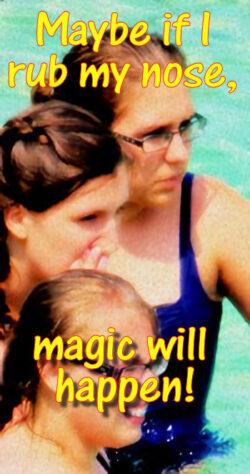
This is a slogan that hung on my therapist’s wall.
Back when we were small, when we wailed are pitched a fit, an adult showed up and made it all better.
Or, if we came from a dysfunctional family, something bad might have happened when we made a noise, but at least something happened.
The expectation was, “I am in pain — you fix it — change it, make it better.”
Lots of folk pull this with their partners — they expect that if they whine long enough and complain loud enough, their partner will be so moved by love, or manipulation, that they will make the boo-boo all better.
If, for some silly reason, the partner tries, then the expectation is this will always happen. If the partner refuses, they’re being stubborn and unloving.
The problem is that rescue is an inside job…
at least for adults. There is no external rescue, not from a partner, not from your relatives, and not from some magical being up in the sky. There is just you, and the life you have created.
The way out: accept total, personal responsibility for who you are, where you are, and what you are doing. Until you give up your belief in external rescue, you are doomed to be “somebody’s baby.”
4. No one will ever love you like mommy and daddy love you.

Lots of dysfunctional fathers and mothers do teach this lesson. They are totally unwilling to let their kids grow up.
They play games to keep the “kids” dependent: to call home, to get permission–and thus to remain childlike adults.
This plays out in many ways.
Some 40 and 50-year-olds are still trying to please their parents — to do what their parents want them to do — and may be stuck in careers they hate, doing stuff they detest, all to get a nod of approval from good old mom and dad.
Others disapprove of who their parents are, and spend decades trying to get them to change — to be the kind of parents they wanted as opposed to the ones they had.
Still others spend decades trying to prove their parents wrong.
Parents raise us the way they do because they have to get us to adulthood — in other words, they have to see to it that we survive. They kiss our owies, pretend they can make things all better, and are our principal arbiters of truth.
They tell us what to think and how to interpret our life experiences.
The key here is, they’re supposed to stop doing this when we grow up. Many do, and will thereafter treat us as adults. Some won’t, and will cling to parenthood– and to bossing their adult children around until they die. That’s just the way it is.
The way out: grow up and get over yourself. While you may choose to be in relationship with your parents until they die, the roles need to change. They need to become adults, and so do you.
Continually vetting your decisions or taking your problems to mommy and daddy is the mark of a fixation on infantile-ism. It’s a cop out.
You’re looking, again, outside of yourself for permission to be who you are.
As an adult, as a self-actualized person, it is always okay to relay data — never okay to ask someone else for permission to be you.
5. Self-exploration is not selfish — it’s essential to discover who you are

Selfish means not sharing your toys. Parents want their children to share, to work together with other people, and to be popular.
Parents would also prefer that their children behave themselves according to the parents’ standards, so they “invite” us to do it their way.
Back in 1968, I had to select which college or university I was going to go to. I had a free ride scholarship to any university in New York State, of which there was at least one in Buffalo.
Mom really wanted me to stay home and go to school in Buffalo.
I decided to go to Elmhurst, Illinois for my BA. Mom said, “Typical. Always thinking of himself.” I smiled, shook my head, and went anyway. I mean, it was my BA, after all!
Self-exploration requires us to step out of others’ expectations. To step out of the herd.
But the pull of the herd is strong, and many, many people will tell you that too much introspection will lead to all sorts of terrible things. What they are really telling you is how scared they are of self-exploration. And then they see you doing it, or trying it, and they freak out.
The way out: You have to discover, through therapy, bodywork, meditation, whatever — what you don’t know — about yourself and about the way the world works.
Not the herd world, but the real, underlying one.
We all need people in our lives who can help us to see what we’re missing — such people are rare, but are there if you look. They have nothing invested in what you can do for them — they’re there to help you open your eyes and truly see. Go find them. Move heaven and earth to work with them, for as long as it takes.
6. Wisdom is different from intelligence

Our society values intelligence – stacking up of more and more data.
There’s nothing wrong with this. It’s just not the whole picture.
Whole picture seeing is a way to describe wisdom. Wisdom is more about putting together than tearing apart. It’s about seeing things as a flow — learning the ways things work together — as opposed to forming judgments, theories, or explanations.
Wisdom is engaging in life as opposed to discussing life.
The way out: choose wisdom.
It’s not easy to be wise while trying to fit in to a herd that prizes brute intelligence.
The wise, in a sense, seem way too simple. They’re not interested in getting involved in deep and meaningful discussions that lead nowhere.
They’re more interested in experimentation — with their lives, with their experiences, with their relationships.
If something works, they do more of it, if something does not work, they stop doing it. Way too simple.
Yet wisdom is the only key that opens the door to true understanding and self-actualization. Cultivating wisdom is the mark of an adult.
7. “Play nice together” is boring
Mom and dad had a vested interest in our being popular. It meant they were good parents. They basked in the reflected glow off their kid’s cherubic little head.
While my mention of herd mentality may be getting boring, you really have got to get this.
We behave ourselves and act nice so as not to offend the herd.
Or at least that’s what we fear will happen if we “let it all hang out.”
The odd piece is that most everyone is bored, bored, bored — bored with cocktail party chatter, bored with meaningless relationships, bored both in the bedroom and in the boardroom.
And I’ve noticed a correlation. Nice people often end up as doormats for the plodding feet of the masses to trod upon.
Even odder, most doormats look up from the floor and thank the people walking over them — “Thank you! So glad to be of service!”
The way out: put a little charge into your life. Experiment with new things. Say what’s on your mind, with elegance, not with anger. Be forthright and honest. This is not a prescription to be a jerk. This is a suggestion that boring is… well… boring. And it’s not like you get a second chance, or a do-over, for your life. Put more of you out there, just because you want to — not for approval.
8. Take a risk

I think my mom and dad did a pretty good job bringing me up and letting me go. Mom had some hanging-on issues, but in general their support and encouragement was excellent.
While perhaps they stepped in a bit too often to keep me from failing at something, after 17 or so they definitely let me stand on my own two feet.
Chiefly, they taught me to take risks.
Now, this flies in the face of most parenting today. It’s like parents want their kids to be encased in a bubble.
Parents seem invested in protecting their kids from everything. Germs. The bogeyman. Whatever.
Never mind that for 100,000 generations kids have been surviving just fine without being bathed in antiseptic.
Modern parents think they know better — the herd tells them so.
The way out: you may have to force yourself, but it’s essential to start taking risks — and by this I mean doing things that are out of your comfort zone. This could be anything from learning to kayak to climbing mountains — to building a new skill set in an area that interests you — invest more in a general exploration of what turns you on.
It may be deciding to experience your feelings, emotions, and the flow of energy in your body, as opposed to blocking or resisting feeling. It may involve leaving one thing or relationship and starting another. Whatever.
You already know what you need to explore next — it’s the thing you’re scaring yourself over.
9. Choose your own bean

As in bean counters.
We learn measures of self-worth from our tribes. In the West, this often has to do with money, possessions, power, and accumulation.
Somehow we’ve been sold a bill of goods that to have more is to be more. So we end up with people with lots of stuff and very little satisfaction.
I therefore encourage my clients to figure out what they’re measuring their self-worth against.
This is not to make light of education, degrees, job titles etc. This is not an exercise in doing away with cultural markers. It’s an exercise in expansion.
If all you ever do is measure yourself against others, if all you ever do is connect your self worth to the height of your pile, you’re likely always going to feel low self-worth — like you just don’t quite measure up.
Comparisons are another “herd mentaility” way to keep you in line.
The way out: I’d like to suggest that an elegant “bean” to use is this — do I know more about myself today? In other words, the mark of progress is in your personal level of self understanding, being self responsible, and being self-actualized. I spend my life removing items from the “I do not know that about myself” list, while adding items to the “Here is what I do and here is who I am” list. Find yourself. A bit more and a bit more each day.
10. Drop your presuppositions.

Everyone has a lot of presuppositions — a lot of rules and regulations, — a lot of concepts for living tucked away in the recesses of their minds.
Lists, in and of themselves, while easy to read, are inherently useless. Many, many people confuse having a list with having wisdom — confuse having a list with doing something.
As a result, they talk a good show while living shallow lives, in a sense waiting for permission to begin living.
And they wait… and they wait… and nothing changes, and life runs out…
The way out: while there is some truth to the corny quote, “I am a human be-ing not a human do-ing,” the mark of full, authentic being is encapsulated in what you do.
Thinking about doing is silly. (This is not to say that planning is silly — this is to say that most people stop with the plan and never get around to doing.)
Many people have plans — about all the things they’re going to do — about how deeply they’re going to self explore.
And then they pull out the other list. This is a list that provides all of the excuses — all the reasons why the first list cannot be enacted now. Not enough time, not enough money, not the right people, not the right relationships, and on and on. But they sure are pleased that they’ve at least got a list. Phooey.
Drop the list making and get on with the walk.